The Biggest Housing Bill in a Generation Just Became Law and Two Provisions Could Hit Florida Harder Than Anywhere Else

The Biggest Housing Bill in a Generation Just Became Law and Two Provisions Could Hit Florida Harder Than Anywhere Else

After months of negotiation and a final round of political drama, the 21st Century ROAD to Housing Act became federal law on July 11, 2026. It's being widely described as the most significant housing legislation since 1990, and it arrived through an unusual path: the bill cleared both chambers of Congress by overwhelming, veto-proof margins  85–5 in the Senate and 358–32 in the House  but the president declined to either sign or veto it, so under the Constitution it became law automatically once the ten-day window closed. However you feel about how it got across the finish line, it's now the law of the land and while it's packed with more than 60 provisions, two of them are aimed squarely at things Floridians deal with every single day: big investors snapping up single-family homes, and the cost of manufactured housing. Let's cut through the noise and talk about what actually changes on the ground here.
 
Start with the one everyone's been shouting about: the crackdown on mega-investors. The new law bars the biggest institutional players — defined as any entity controlling at least 350 single-family homes from buying more of them, with a few carve-outs for build-to-rent and rent-to-own programs. This is the "get Wall Street out of the way of families" provision, and it enjoys huge public support across party lines. Here's why it matters more in Florida than in most of the country: while big investors own only about 2% of single-family homes nationally, their footprint is wildly concentrated in exactly the kind of Sun Belt metros we have all over this state.
 
Jacksonville is ground zero. According to a Government Accountability Office estimate, institutional investors own roughly 21% of Jacksonville's single-family rental market  one of the highest concentrations in the entire country and Tampa sits around 15%. For years, that meant regular buyers in these markets kept losing out to corporations making all-cash offers with lightning-fast closings. If you've had a first-time buyer client get beaten out by a faceless LLC three times in a row, you know exactly the frustration this provision is trying to fix. In the neighborhoods where these big players were most active, everyday buyers may finally get a little more breathing room to compete.
 
But here's where you need to keep it real with your clients, because the honest picture matters. Economists are broadly skeptical that this provision alone will move prices much. Even in Florida's most investor-heavy metros, large institutions were only ever a slice of total purchases — and the 350-home threshold means the countless smaller "mom-and-pop" investors, who actually make up a bigger share of buying in places like Jacksonville, aren't touched by the law at all. So the realistic take is: this helps at the margins, in specific neighborhoods, for specific buyers. It's a tailwind, not a tidal wave. Anyone promising it'll crash prices or flood the market with cheap homes is overselling it.
 
Now for the sleeper provision that almost nobody is talking about — and the one I think could actually move the needle more for Florida buyers. The law eliminates a decades-old federal rule that required every manufactured home to be built on a permanent steel chassis, that heavy metal frame originally meant for towing. The catch? The overwhelming majority of manufactured homes never move again after they're set in place. That chassis was a rolling tax on affordability that most homeowners never used.
 
Removing it could knock an estimated $5,000 to $10,000 off the price of a manufactured home — which, on many of these homes, is more than 10% of the total cost. And there's a bonus: without that bulky frame required between floors, two-story manufactured homes suddenly become far more feasible, opening up designs that actually look and live like traditional houses. For an entry-level buyer priced out of a site-built home, that's not a rounding error. That's the difference between renting for another three years and owning now.
 
Florida is practically the perfect laboratory for this. We're one of the biggest manufactured-housing markets in the nation, with massive communities and rock-solid demand across Tampa, Orlando, and Fort Myers, fueled by retirees and the steady wave of buyers fleeing high-cost Northeastern states. Newer Florida communities are already being built to enhanced hurricane standards, chipping away at the old stigma and the insurance headaches. Make factory-built homes cheaper to produce, and you're pouring fuel on an affordable-housing segment that Florida already does better than almost anyone. That could mean more inventory at the entry level, more first-time buyers getting in the door, and a whole category of sales that too many agents have historically ignored.
 
So what's the bottom line for home sales going forward? Don't expect fireworks this quarter these provisions unfold over years, not weeks. But the direction is clear and it favors the buyers who've been squeezed the hardest. Less big-investor competition in Jacksonville and Tampa, cheaper and better manufactured homes statewide, and a slow but real widening of the on-ramp to ownership. It's a foundation-laying law, not a switch that flips overnight  but the foundation it lays tilts toward everyday Florida buyers.
 
For real estate professionals, the practical takeaway is less about the politics and more about the conversation. Clients will be reading the same headlines and asking what all this means for them, and the agents and lenders who understand these shifts who can walk a nervous first-time buyer through what actually changed, where the new opportunities are, and why the real effects unfold over years rather than months  are the ones who'll turn this legislation into closings. The market is shifting under our feet. The question is whether you'll be the professional who saw it coming.
Three Months, One Trend, Zero People Talking About It. And That Fence You’re Sitting On Has Splinters

Three Months, One Trend, Zero People Talking About It. And That Fence You’re Sitting On Has Splinters

There's a story the headlines love to tell right now: the world is uncertain, buyers are scared, and everyone's smart move is to "wait and see." But the actual data just told a very different story — and if you've been sitting on the fence waiting for a sign, this is it. According to the latest Mortgage Bankers Association report for the week ending June 26, mortgage application activity ticked *up*. Not down. Up. In a moment when every instinct is telling people to freeze, a growing number of buyers are quietly doing the opposite — and they're the ones who are going to come out ahead.
 
Look closer at the number that matters most. Purchase applications rose 1% week over week, and on an unadjusted basis jumped 11% — landing **3% higher than the same week a year ago**. That may not sound explosive, but here's the part that should stop you cold: purchase demand has now posted year-over-year growth for **nearly three straight months**. That's not a blip or a fluke. That's a trend. While the loudest voices are preaching caution, the buyers who are actually in the game keep showing up, week after week, and steadily pulling ahead of last year's pace.
 
The reason is simple, and it's the exact opposite of what fear would have you believe. As the MBA's deputy chief economist Joel Kan put it, prospective homebuyers are *"finding opportunities in markets with ample inventory and easing home-price growth."* Read that again. Opportunity. More homes to choose from. Prices that have stopped sprinting away. The people winning right now aren't the ones who timed some perfect bottom — they're the ones who understood that a calmer, better-supplied market is a *gift* to a prepared buyer, not a threat.
 
And here's the quiet detail almost nobody is talking about: adjustable-rate mortgages dropped to under 8% of all applications, the lowest share since January. Translation? Today's buyers aren't gambling. They're not stretching into risky products or crossing their fingers on rates. They're locking in real, stable financing and moving forward with confidence. This is a market being driven by serious, informed buyers not speculation, not hype. That's exactly the kind of foundation that rewards the people who act with intention.
 
Now let's talk about the elephant in the room: uncertainty. Yes, there's plenty of it — economically, globally, politically. And that's precisely why this data is so powerful. The strength we're seeing isn't happening in some perfect, calm environment. It's happening *in spite of* the noise. When buyers keep transacting through a cloud of headlines and hand-wringing, that's not fragility — that's resilience. A market that holds strong under pressure is a market you can trust. The uncertainty isn't the reason to wait. It's the backdrop that the winners are choosing to move through anyway.
 
Because here's the hard truth for anyone still parked on the sidelines: waiting has a cost, and that cost is compounding right now. Every week you sit still, a more decisive buyer is out there getting the inventory, negotiating the terms, and locking the financing you told yourself you'd get to "later." The homes with the most choice and the most negotiating room don't wait for you to feel comfortable. The buyers pulling ahead of last year's pace aren't smarter than you — they just stopped waiting for permission that was never going to come.
 
Let's be honest about what "waiting for the perfect moment" really is. It's a story we tell ourselves to avoid the discomfort of a decision. But the perfect moment — rock-bottom rates, rock-bottom prices, zero uncertainty, and a guarantee it all works out — has never existed and never will. The buyers building wealth in real estate have always been the ones who acted on good information in an imperfect world. That's not recklessness. That's how it's always worked. And the data says that window is open right now.
 
So here's the message underneath all these numbers, and I want to say it plainly: the market is stronger than the fear, and the people who recognize that are getting rewarded while the sidelines get more crowded. Purchase demand is up. Inventory is healthier. Financing is stable. Buyers are moving with confidence through more uncertainty than we've seen in years — and they're outpacing the crowd that's still "thinking about it." Don't be the person who looks back a year from now and realizes the sign you were waiting for was staring at you the whole time.
 
If you've been on the fence, let's have a real conversation — not a sales pitch, an honest look at your numbers, your goals, and what this market actually means for *you*. The buyers who win don't do it alone; they do it with a professional who knows how to read the moment and move at the right time. The data is clear, the opportunity is real, and the only question left is whether you'll be in the game or watching it from the sidelines. Let's talk. 👇
The Affordability “Crisis” Everyone’s Panicking About? In South Florida, It’s the Biggest Opportunity in a Decade.

The Affordability “Crisis” Everyone’s Panicking About? In South Florida, It’s the Biggest Opportunity in a Decade.

Every headline this year wants you to believe the same thing: housing is broken, buyers are frozen, and the American dream is on life support. Nearly three-quarters of U.S. homes get called "unaffordable," first-time buyers are now hitting age 40, and the word "crisis" is stamped on every real estate story that crosses your feed. And look, the challenges are real. But here's what those doom-scroll headlines miss, and what every sharp agent in South Florida already feels in their gut: a shifting market isn't a closing door. It's a door swinging wide open for the professionals who know how to walk through it.
 
Start with the number that actually matters for our clients. Realtor.com's midyear update shows home price growth cooling to just 1.2% for 2026 and because inflation is running faster than that, homes are effectively getting *cheaper* in real terms for the second year in a row. Mortgage payments are projected to dip nearly **2%**, incomes are climbing about **3.9%**, and for the first time since 2022, the typical mortgage is expected to drop below that magic **30% of income** affordability threshold. Translation for South Florida: the buyers who got scared off the last three years are quietly regaining their power, and they need a guide who can show them the math instead of the fear.
 
Then there's the psychology of the market, which is the part the algorithms will never capture. Realtor.com's chief economist put it perfectly: *"This is a market where people are adjusting and showing up rather than giving up."* Sellers are meeting the moment with realistic pricing, buyers are gaining negotiating room, and — this is the beautiful part — price cuts are actually *rarer* this year than last, because sellers priced smart from the start. Down here, that means less panic, more deals, and a client base that finally wants to move again. That's not a crisis. That's momentum, and momentum rewards the agents who are actually in the arena.
 
Here's another angle the headlines bury: South Florida runs on migration, and migration doesn't care about a national affordability average. Buyers keep flowing in from the pricey Northeast — where prices are *up double digits* since 2022 cashing out high up north and landing here with serious buying power. Retirees are still flocking to Florida. Remote professionals still want sunshine, no state income tax, and a lifestyle the rest of the country is jealous of. Every one of those relocations is a client who needs a local expert. The question isn't whether the buyers are coming. It's whether they're going to find *you* when they get here.
 
And let's talk about the piece most agents completely ignore: renters. With rents softening and homeownership finally inching back within reach, the country is sitting on the single largest pool of future first-time buyers in modern history  a generation that's been renting longer than any before it. That's not a sad statistic. That's a pipeline. The agent who builds relationships with renters today, who teaches them, who earns their trust before they're ready to buy, is the agent who owns the next five years of closings. At CANVAS Real Estate, that's exactly the kind of long-game, relationship-first thinking we build our agents around.
 
Because here's the truth nobody tells you when you're grinding it out solo: in a shifting market, *who you're standing next to matters more than ever*. The agents who thrive right now aren't the ones with the flashiest listings  they're the ones with the best training, the sharpest data, the strongest support system, and a brand that opens doors before they even knock. When the market is easy, anyone can look good. When the market demands skill, the right brokerage behind you is the difference between surviving and scaling. That's the entire reason CANVAS exists.
 
We built CANVAS Real Estate for exactly this moment  for the agent who sees opportunity where others see obstacles, who wants real mentorship instead of empty promises, and who's tired of feeling like just another name on a roster. We give our people the tools, the technology, the marketing muscle, and the culture to turn a "tough" market into their best year yet. Our agents don't fear headlines like this one. They screenshot them, because they know every panicked buyer and every hesitant seller is someone who needs a professional who actually understands what's happening. And that professional gets *made* inside the right environment.
 
So if you're an agent reading this and feeling the pull  that quiet sense that you're capable of more than your current situation is letting you become  take it as your sign. The market is handing South Florida a generational opening, and the only thing standing between you and it is the team you choose to build it with. **Let's build it together at CANVAS Real Estate.** The buyers are showing up. The sellers are showing up. The only question left is: will you? 👇 Drop a comment or send me a message  let's talk about what your next chapter looks like.
The Crash Didn’t Happen and  Mega‑Sales Are Reshaping South Florida Real Estate

The Crash Didn’t Happen and  Mega‑Sales Are Reshaping South Florida Real Estate

South Florida isn’t waiting around for a market crash. In the last two months, a string of record‑setting luxury sales has sent a clear message: high‑net‑worth buyers are still pouring money into our market and they’re paying premiums for the very best properties. If you’re a buyer sitting on the sidelines, these deals are proof that waiting for the “perfect time” could mean missing out. Luxury investors aren’t timing the market — they’re choosing irreplaceable locations. That is exactly why owning in South Florida today is still a compelling long‑term play.
 
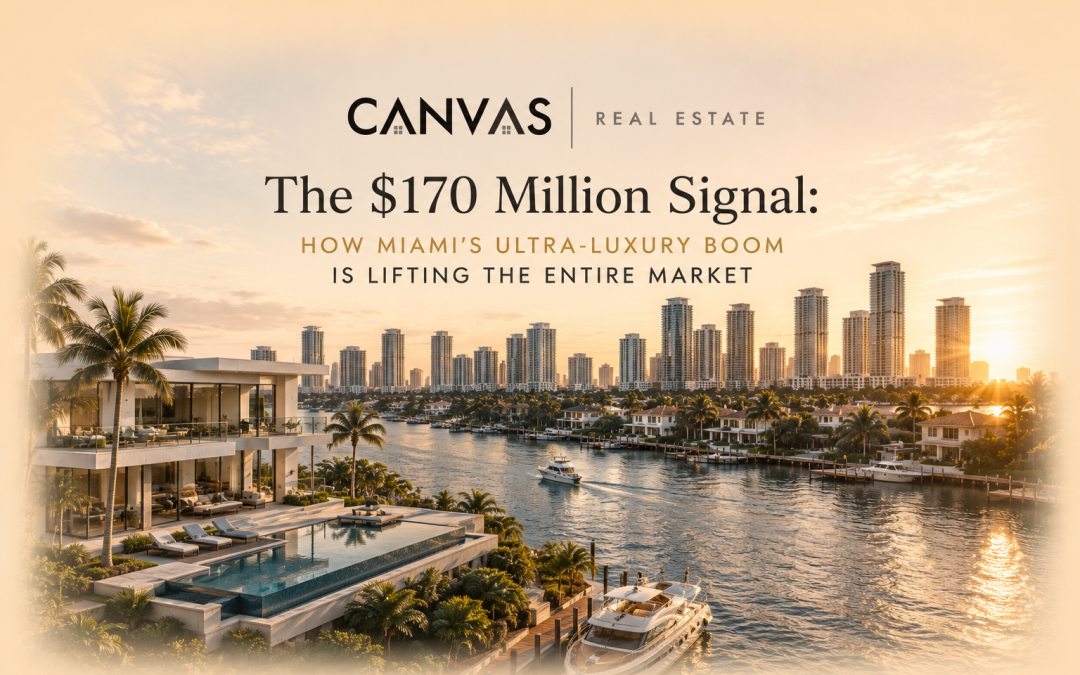
One of the clearest signs of this confidence came on 20 May 2026 when a spec mansion in Boca Raton’s exclusive Royal Palm Yacht & Country Club sold for $75 million. Built by SRD Building Corp., the estate sits on nearly an acre with 292 feet of water frontage and a 110‑foot private dock. The eight‑bedroom, 24,000‑square‑foot home includes a wellness wing, golf simulator, game room and six‑car garage. Broker David Roberts noted that the sale was the highest single‑family sale in Boca Raton’s history, and he attributed it to buyers seeking “generational‑quality waterfront estates”. When a newly built mansion doubles the city’s previous record price, it resets expectations for every other seller and sends a powerful signal that premium properties remain coveted.
 
Two weeks later, Palm Beach saw an even larger transaction: an under‑construction mansion on Everglades Island traded for $93.3 million. The seller had purchased the 0.9‑acre lot for $39.5 million in 2021 and obtained approval for an 11,600‑square‑foot home with nautical details. Closing at more than twice the land’s 2021 price before the house was even finished shows that buyers aren’t just chasing completed homes — they’re snapping up future inventory in prized locations. It’s a reminder that scarcity drives value and that South Florida waterfront property remains a blue‑chip asset.
 
This wave of mega‑deals isn’t limited to finished homes. WeatherTech founder David MacNeil sold a double vacant lot in Manalapan for $105 million. The 3.63‑acre site spans 342 feet on both the Atlantic Ocean and the Intracoastal Waterway, offering a blank canvas for a future estate. MacNeil had assembled the land in 2024 and 2025 at a cost of roughly $94 million, then listed it for $125 million late last year. Even at a slight discount, the sale ranks among the most expensive land deals ever in Florida and underscores the appetite for trophy properties that can never be replicated.
 
Another example of buyers’ willingness to pay for exclusivity is the $62.5 million sale of a 27,959‑square‑foot estate at 820 South Ocean Boulevard in Manalapan. The ocean‑to‑Intracoastal property includes a guest house, wellness complex, library, theater, wine cellar and recording studio. The seller, biotech billionaire Randal Kirk, had listed it for $134 million in 2025 before reducing the ask; nonetheless, the closing price still represents a substantial increase over the $25.5 million he paid in 2011. This type of appreciation over a decade demonstrates the wealth‑preservation power of South Florida real estate.
 
Not all confidence‑boosting deals are nine‑figure transactions, but many of them still set eye‑watering benchmarks. In Surfside, Fort Partners sold a 7,900‑square‑foot penthouse at Seaway at The Surf Club North for $41 million, or about $5,200 per square foot — one of the highest condo prices on record. In the same week, a 4,500‑square‑foot home in Palm Beach traded for $21 million, more than $4,700 per square foot, and a nearly one‑acre vacant lot in Coral Gables fetched $14.9 million. These numbers might seem detached from the average buyer, but they matter: record‑setting price per square foot on condos, single‑family homes and land shows that demand is broad‑based across property types.
 
June’s end brought another batch of headline‑grabbing sales. A Palm Beach home at 350 Island Road sold for $35 million — about $6,100 per square foot — demonstrating that the $30‑to‑$40 million range remains active. The same report noted a newly built Palm Beach home at 232 La Puerta Way that sold for $18.4 million. And just days later, on 1 July, another Palm Beach residence at 242 Wells Road closed for $21 million, while a 9,300‑square‑foot beachfront home in Jupiter Inlet sold for $15.25 million. Across Miami Beach and Lighthouse Point, properties continued to trade in the $10–$15 million range. The steady drumbeat of eight‑ and nine‑figure closings indicates that ultra‑luxury demand isn’t episodic — it’s sustained.
 
For agents, these transactions are a wake‑up call. Real estate isn’t just about quoting interest rates; it’s about understanding where capital is moving and why. The buyers driving these deals are sophisticated; they have global options and they’re choosing South Florida because of its tax advantages, lifestyle, and long‑term appreciation. Realtors who ignore the ultra‑luxury segment or dismiss record sales as “irrelevant” risk missing the very indicators that influence every price point. At CANVAS Real Estate, we train agents to interpret market signals, build relationships with high‑net‑worth buyers and sellers, and leverage these marquee sales to educate all clients. If you’re a Realtor who wants to grow your business, now is the time to align with a brokerage that understands how to translate record sales into broader market confidence.
 
What do these headline deals mean for everyone else? Confidence at the top filters down. When $75 million mansions and $40 million penthouses sell, it tells mid‑market homeowners and investors that South Florida remains a desirable, stable place to park capital. Wealthy buyers could put their money anywhere; choosing Miami‑Dade, Broward and Palm Beach counties signals faith in our region’s future. This confidence supports property values at every level and attracts more development, restaurants, hotels and corporate relocations.
 
The bottom line: don’t let doomsday headlines keep you on the sidelines. The past 60 days prove that buyers with the most to lose continue to invest heavily in South Florida real estate. Whether you’re shopping for a condo, a single‑family home or a long‑term investment property, the market fundamentals remain strong — and the world’s wealthiest buyers agree. Reach out today to learn how to leverage this momentum and secure your place in one of the most dynamic and resilient markets in the country.
Miami It’s Becoming Corporate America’s New Power Address

Miami It’s Becoming Corporate America’s New Power Address

If you are waiting for South Florida real estate to collapse before making a move, you may be watching the wrong signal. The real story is not just mortgage rates, inventory, or price reductions. The bigger story is that companies are moving people, money, offices, and executives into South Florida  and those people need somewhere to live.

According to Realtor.com, the national office vacancy rate is around 17.6%, which means much of the country is still dealing with empty office space. South Florida is telling a very different story. The West Palm Beach-Boca Raton office market has only an 11.3% vacancy rate, and Miami is close behind at 12.8%. Even more impressive, Brickell’s office vacancy rate is just 3.7%, driven by major corporate tenants like Citadel, Microsoft, and Banco Santander at 830 Brickell.

That matters for buyers because jobs create housing demand. This is not just a lifestyle migration story anymore. It is a corporate relocation story. ServiceNow leased about 200,000 square feet at 10 CityPlace in West Palm Beach. Wells Fargo took more than 50,000 square feet at One Flagler. In Miami, Amazon leased 50,000 square feet in Wynwood, while Palantir established its headquarters there. Apple, Uber, Verizon, and other major companies have also clustered into the South Florida market.

So here is the call to action for buyers: stop asking only, “Are prices coming down?” and start asking, “Where is future demand being created?” If major companies are filling offices while the rest of the country is struggling with vacancies, that says something powerful about long-term confidence in South Florida. The smartest buyers are not trying to time the exact bottom. They are looking for neighborhoods where income, jobs, corporate expansion, and lifestyle demand are all moving in the same direction.

The housing impact is already showing up neighborhood by neighborhood. Realtor.com reported that corporate employees are gravitating toward areas like Brickell, Coconut Grove, Miami Beach, Downtown Miami, Key Biscayne, Coral Gables, and Wynwood. Younger professionals are often choosing high-end rentals and condos close to work, restaurants, nightlife, gyms, security, parking, and amenities. Senior executives and families are often moving toward privacy, larger lots, waterfront access, top schools, and more residential neighborhoods.

And this is where Realtors need to wake up. The agents who keep talking only about rates are missing the bigger business opportunity. Corporate relocation, luxury rentals, executive buyers, foreign capital, high-net-worth investors, and neighborhood-specific lifestyle guidance are becoming essential conversations in South Florida. If you are a Realtor and you are not positioning yourself as a relocation and market advisor, you are leaving serious money on the table.

At CANVAS Real Estate, this is exactly why we train agents to think bigger than one transaction. The next wave of opportunity will not go to agents who simply open doors. It will go to agents who understand the relationship between jobs, office leasing, wealth migration, school zones, condo demand, luxury housing, and long-term neighborhood growth. If you are an agent who wants to build a real business — not just chase leads — this is the market you should be studying.

What is fascinating is that even with all this corporate momentum, buyers may still have more room to negotiate than they had during the pandemic boom. Realtor.com reported that the Miami-West Palm Beach metro residential market had softened, with a median list price of $499,000, down 2.2%, and 15.3% of listings showing price reductions. That is not a crash. That is a window where serious buyers can potentially find value while long-term demand drivers remain strong.

South Florida is no longer just a vacation market, retirement market, or pandemic escape market. It is becoming a corporate power market. When office buildings are filling, executives are relocating, luxury buyers are comparing Miami value to New York, California, and Chicago, and major employers are planting flags here, the message is clear: the foundation under South Florida real estate is deeper than the headlines suggest. The question for buyers and Realtors is simple  are you going to react to the noise, or are you going to follow where the money is actually moving?

The Headlines Got Florida Real Estate Wrong. Again

The Headlines Got Florida Real Estate Wrong. Again

The biggest shift isn't demand it's leverage. Buyers today have something they haven't enjoyed in years: options. Inventory has grown, sellers are negotiating, and concessions are becoming more common. That doesn't mean Florida is weak. It means we're returning to what many would consider a healthier, more balanced market where informed buyers can negotiate without the bidding wars that defined the pandemic years.

That should change the conversation for consumers. Instead of asking, "Should I wait for prices to fall?" a better question is, "Can I negotiate a better deal today than I could two years ago?" The answer for many buyers is yes. In real estate, your purchase price, financing terms, and seller concessions often have a greater impact on your long-term return than trying to perfectly time the market.

For sellers, this market requires a different strategy than it did in 2021 or 2022. Pricing correctly from day one matters more than ever. Buyers have choices, and overpriced listings are no longer receiving automatic offers. The homes that are selling are the ones that are well-presented, competitively priced, and marketed aggressively. Success today comes from preparation—not simply putting a sign in the yard.

For Realtors, this market is separating advisors from order takers. The agents winning today aren't waiting for lower interest rates or hoping inventory shrinks. They're educating clients on financing strategies, negotiating stronger contracts, and helping buyers recognize opportunities that didn't exist just a few years ago. Markets like this reward knowledge, not luck.

Investors are paying attention for the same reason. They understand that the best opportunities often appear when uncertainty causes others to hesitate. While appreciation may be more modest than during the pandemic boom, improving inventory, resilient demand, and Florida's continued population growth continue to support the state's long-term outlook.

The lesson is simple: stop letting headlines make your real estate decisions. Headlines are designed to generate clicks. Wealth is built by understanding market cycles, recognizing value, and making informed decisions based on facts rather than fear. Florida's market isn't behaving like the boom years, but it isn't behaving like a crash either. It's becoming a market where expertise once again matters.

Whether you're buying your first home, selling your current one, investing in your next property, or building a real estate career, this is the time to lean into education not emotion. The agents who can interpret the market instead of simply reporting it will earn their clients' trust, grow their businesses, and help shape the next chapter of Florida real estate.

1 3 4 5 6 7 14