If you are waiting for South Florida real estate to collapse before making a move, you may be watching the wrong signal. The real story is not just mortgage rates, inventory, or price reductions. The bigger story is that companies are moving people, money, offices, and executives into South Florida and those people need somewhere to live.
According to Realtor.com, the national office vacancy rate is around 17.6%, which means much of the country is still dealing with empty office space. South Florida is telling a very different story. The West Palm Beach-Boca Raton office market has only an 11.3% vacancy rate, and Miami is close behind at 12.8%. Even more impressive, Brickell’s office vacancy rate is just 3.7%, driven by major corporate tenants like Citadel, Microsoft, and Banco Santander at 830 Brickell.
That matters for buyers because jobs create housing demand. This is not just a lifestyle migration story anymore. It is a corporate relocation story. ServiceNow leased about 200,000 square feet at 10 CityPlace in West Palm Beach. Wells Fargo took more than 50,000 square feet at One Flagler. In Miami, Amazon leased 50,000 square feet in Wynwood, while Palantir established its headquarters there. Apple, Uber, Verizon, and other major companies have also clustered into the South Florida market.
So here is the call to action for buyers: stop asking only, “Are prices coming down?” and start asking, “Where is future demand being created?” If major companies are filling offices while the rest of the country is struggling with vacancies, that says something powerful about long-term confidence in South Florida. The smartest buyers are not trying to time the exact bottom. They are looking for neighborhoods where income, jobs, corporate expansion, and lifestyle demand are all moving in the same direction.
The housing impact is already showing up neighborhood by neighborhood. Realtor.com reported that corporate employees are gravitating toward areas like Brickell, Coconut Grove, Miami Beach, Downtown Miami, Key Biscayne, Coral Gables, and Wynwood. Younger professionals are often choosing high-end rentals and condos close to work, restaurants, nightlife, gyms, security, parking, and amenities. Senior executives and families are often moving toward privacy, larger lots, waterfront access, top schools, and more residential neighborhoods.
And this is where Realtors need to wake up. The agents who keep talking only about rates are missing the bigger business opportunity. Corporate relocation, luxury rentals, executive buyers, foreign capital, high-net-worth investors, and neighborhood-specific lifestyle guidance are becoming essential conversations in South Florida. If you are a Realtor and you are not positioning yourself as a relocation and market advisor, you are leaving serious money on the table.
At CANVAS Real Estate, this is exactly why we train agents to think bigger than one transaction. The next wave of opportunity will not go to agents who simply open doors. It will go to agents who understand the relationship between jobs, office leasing, wealth migration, school zones, condo demand, luxury housing, and long-term neighborhood growth. If you are an agent who wants to build a real business — not just chase leads — this is the market you should be studying.
What is fascinating is that even with all this corporate momentum, buyers may still have more room to negotiate than they had during the pandemic boom. Realtor.com reported that the Miami-West Palm Beach metro residential market had softened, with a median list price of $499,000, down 2.2%, and 15.3% of listings showing price reductions. That is not a crash. That is a window where serious buyers can potentially find value while long-term demand drivers remain strong.
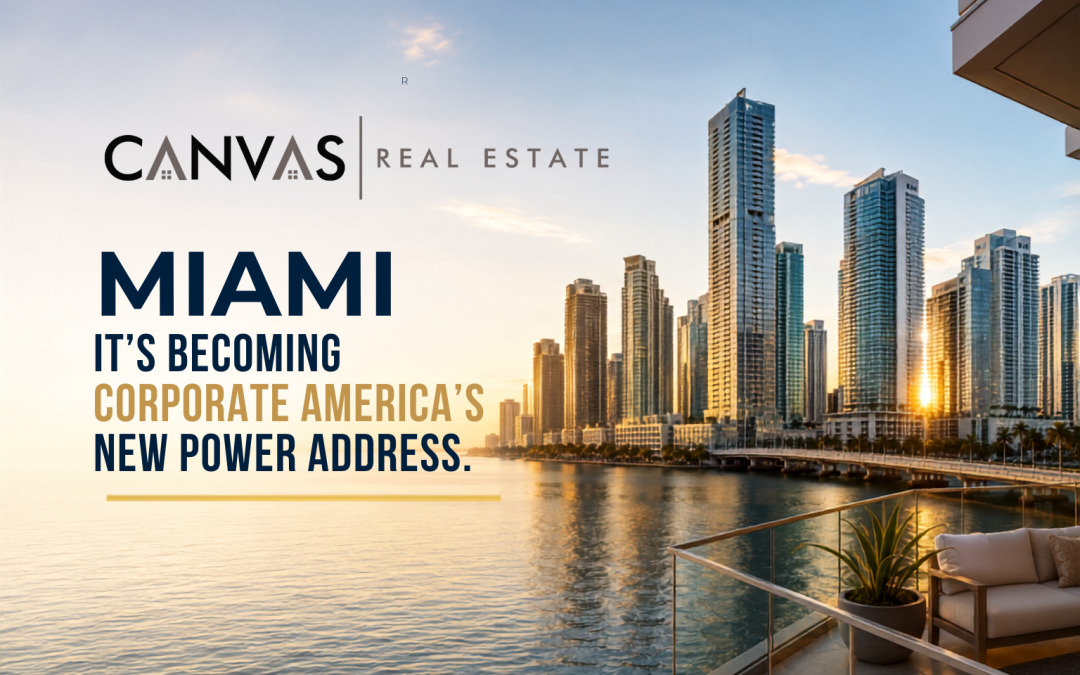
South Florida is no longer just a vacation market, retirement market, or pandemic escape market. It is becoming a corporate power market. When office buildings are filling, executives are relocating, luxury buyers are comparing Miami value to New York, California, and Chicago, and major employers are planting flags here, the message is clear: the foundation under South Florida real estate is deeper than the headlines suggest. The question for buyers and Realtors is simple are you going to react to the noise, or are you going to follow where the money is actually moving?