
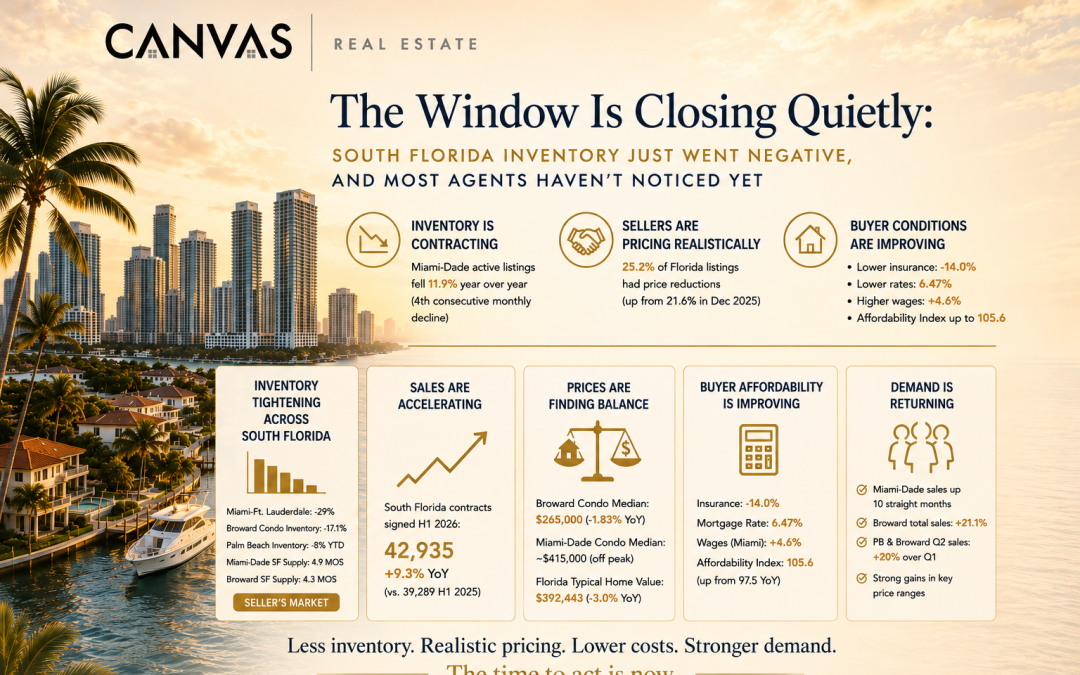
For two years the story in South Florida was oversupply. Condo inventory ballooning, days on market stretching, buyers taking their time. That story is over, and the data says so plainly but the narrative hasn't caught up, which means there's a window right now for the agents and loan officers paying attention. Miami-Dade's total active listings fell 11.9% year over year in May 2026, from 18,879 to 16,615, marking the fourth consecutive monthly decline. Statewide, Florida ended April with 101,024 active single-family listings, down 13.7% from a year earlier. Inventory isn't "about to" go negative in South Florida. It already has, and it's accelerating in that direction.
Look at the county-level numbers and the trend gets sharper. In the Miami–Fort Lauderdale–Pompano Beach metro, single-family inventory has tightened 29% year over year to 13,319 active listings. Broward's condominium inventory the segment everyone spent 2025 calling a glut fell 17.1% year over year in June 2026, from 11,686 listings to 9,688. Palm Beach County inventory dropped 8% year to date and now sits roughly 11% below its 2016–2019 average, while Broward is 4% below pre-pandemic norms. Both counties fell below pre-pandemic inventory levels for the first time since 2022. Months of supply tells the same story: Miami-Dade single-family is at roughly 4.9 months and Broward at 4.3 both squarely seller's-market territory by MIAMI Realtors' own classification.
Here's the mechanic driving it, and it's the part worth understanding because it explains why this reverses faster than people expect. Supply is shrinking from both ends at once. On one end, sales are absorbing it South Florida contracts signed hit 42,935 in the first half of 2026, up 9.3% from 39,289 a year earlier. On the other end, sellers are simply leaving. New listings across South Florida totaled 64,155 in the first half, down 7.8% year over year, with declines showing up in nearly every month for both houses and condos. Statewide, one tracker attributed a 10.9% inventory decline specifically to sellers withdrawing listings, with delistings in some Florida markets running roughly 2.4 times their two-year norm in June 2026. The reasons are rational: owners holding sub-4% mortgages won't sell into softness and re-buy at 6.5%, and sellers anchored to 2022 valuations would rather pull the sign than book a loss. Whatever the motive, the effect on the board is identical fewer homes for your buyer to choose from every single month.
Now the second half of the story, and this is the one that actually helps your buyers: the listings that stayed are getting priced honestly for the first time in four years. Price reductions climbed back to 25.2% of Florida listings by mid-2026, up from a low of 21.6% in December 2025 one in four sellers meeting the market instead of waiting for it. Broward's condo median came in at $265,000 in June, down 1.83% year over year. Miami-Dade's condo median has been running near $415,000, off meaningfully from its peak. Statewide, Florida's typical home value settled around $392,443 in May, down 3.0% year over year. That's not a collapse — it's price discovery, and it is exactly what a market needs after a run like 2021–2022. Sellers who price to today's reality are moving: Miami-Dade single-family homes went under contract in a median of 52 days in June.
And the payment math has genuinely changed, which is the part most agents haven't recalculated. Citizens Property Insurance rolled out premium reductions starting in spring 2026 averaging 14.0% for Miami-Dade policyholders, against an 8.7% statewide average, with at least 17 private insurers having re-entered Florida since the 2022–2023 reforms. Insurance was the fastest-growing line item at closing for three straight years; it's now moving the other direction. Mortgage rates averaged 6.47% in mid-June 2026, down from 6.81% a year prior. Wages in the Miami metro rose 4.6% for the year ending March 2026 the largest increase among the fifteen largest U.S. metropolitan areas, against 3.4% nationally. NAR's Housing Affordability Index climbed to 105.6 in May 2026 from 97.5 a year earlier. Lower insurance, lower rates, higher wages, softer condo prices: four variables, all moving in the buyer's favor at the same time. That has not happened here since 2019.
Buyers have already noticed, even if the headlines haven't. Miami-Dade total home sales rose year over year for the ninth consecutive month in May and the tenth in June the county's best June in three years. Broward posted its fourth straight month of annual gains in June, with total sales up 21.1%, single-family transactions up 26%, and condo sales up 15.5%. The action isn't confined to the top, either: Broward condo sales in the $400,000–$500,000 range surged 26% year over year, and Miami-Dade condo sales between $200,000 and $300,000 jumped 23%. Palm Beach and Broward each saw second-quarter sales climb more than 20% over the first quarter. Demand is returning to the exact price points where working South Florida families buy.
So here is the play for the back half of 2026, and it's less about prospecting than it is about excavation. Your database is full of people who were told "not right now" between 2023 and 2025 the buyer whose debt-to-income failed on a $9,000 insurance quote that is now $7,700; the condo shopper who walked when the building's assessment landed; the family that got priced out at 7.1% who hasn't run the numbers at 6.4% with a year of raises behind them. Those files aren't dead leads. They're pre-qualified relationships whose underlying math moved without them knowing it. This is where the loan officer–agent partnership earns its keep: pull the CRM, sort by "declined" and "paused," and re-run them together. Know the specifics that will come up like the fact that of 2,397 condominium buildings across Miami-Dade, Broward, and Palm Beach, only a handful are FHA-approved, which determines which buildings your entry-level buyer can actually finance. The agent who can answer that question on the first call wins the client.
Markets don't send out announcements when they turn. They just quietly stop offering what they were offering six months ago, and the people who were still working through the slow stretch are the ones holding the relationships when volume returns. Inventory is contracting, sellers are pricing realistically, carrying costs are falling, wages are rising, and sales have climbed for ten straight months in the largest county in the state and a meaningful share of agents have spent this year waiting for a signal instead of reading one. If you've been thinking about where to take your business, or who to build it alongside, this is the stretch that decides who owns 2027. The buyers are already calling. The question is whose number they have.