
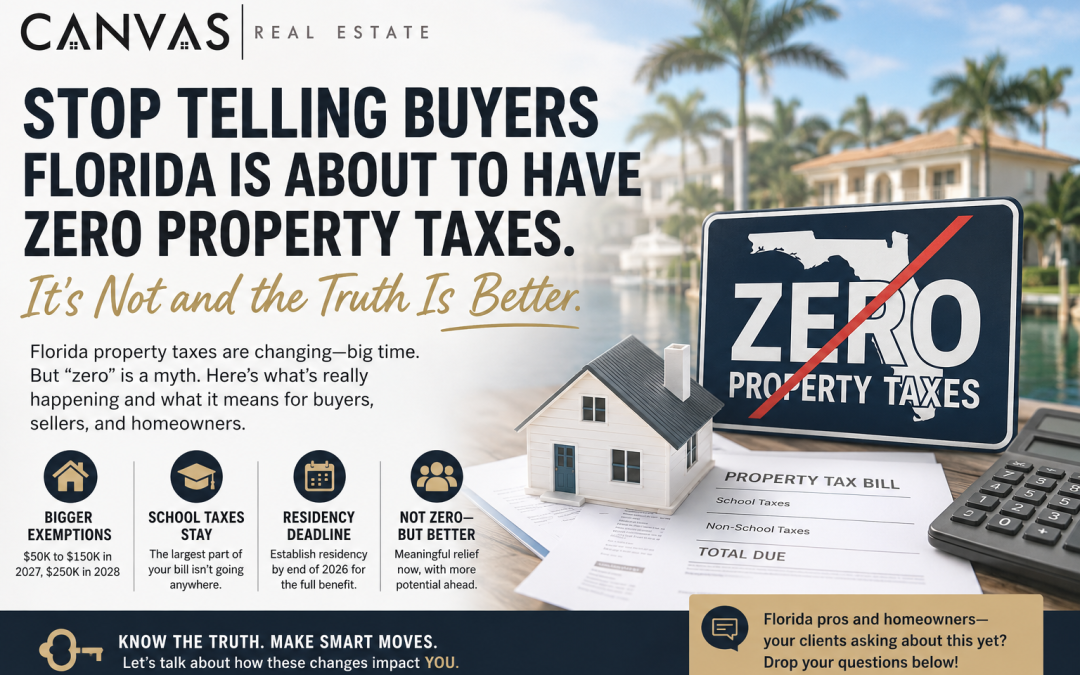
There's a rumor sprinting through every Florida open house and group chat right now: "Property taxes are about to disappear!" And I get why Governor DeSantis has spent more than a year floating the idea of completely eliminating property taxes on homesteads, and the headlines have run wild with it. But here's the reality every honest agent, buyer, and seller needs to hear before they make a six-figure decision based on a soundbite: the property tax bill that actually passed does NOT take your taxes to zero. Not for most people, not in 2027, and not on the part of your bill that's usually the biggest. Let's separate the headline from what's really on the table.
Here's what's actually happening. In June 2026, the Legislature passed HJR 1-F — a DeSantis-backed constitutional amendment that goes to voters this November. If 60% of Floridians approve it, the homestead exemption on non-schoolproperty taxes jumps from the current $50,000 to $150,000 on January 1, 2027, then to $250,000 in 2028, indexed to inflation after that. That's real, meaningful relief. But read that one word again: non-school. The single largest chunk of most Florida property tax bills is the school district levy — and this amendment doesn't touch it. So even in the best-case scenario, your "zero" still has a school-tax line item sitting right there on the bill.
So who actually hits zero? A narrower group than the hype suggests. If your home's non-school taxable value falls entirely under the exemption think lower-priced homes in lower-millage areas — your non-school portion could genuinely drop to nothing. But for a median or above-median Florida home, and certainly for anyone in a high-value market like Miami or the coasts, the exemption takes a serious bite without erasing the bill. The Florida Senate itself framed this as setting up "the framework for full exemption over time" — meaning even the people who wrote it are telling you the full wipeout is a future aspiration, not a 2027 reality. "Over time" is doing a lot of heavy lifting in that sentence.
And here's the catch that matters enormously for anyone relocating which, if you sell Florida real estate, is a huge slice of your pipeline. The expanded exemption rewards existing residents. To get the full benefit when it kicks in, you generally need to have established primary Florida residency by the end of 2026. Move to Florida after that deadline and you're looking at a far smaller exemption reporting points to as little as $50,000 for your first years in the state before you phase up. So that buyer from New York or New Jersey you're courting with "Florida's about to have no property taxes"? They could be the exact person who doesn't get the big break for years. Misrepresent that, and you've got a furious client and a liability problem. Get it right, and you've got a reason for them to buy this year instead of waiting.
Now zoom out, because this is where the "why it'll never be truly zero" gets real. Property taxes fund roughly 74% of local tax collections in Florida schools, police, fire, roads, parks. The state's own Revenue Estimating Conference pegged one earlier elimination proposal at a $13.3 billion recurring hit to local budgets, with analysts warning that some counties could lose close to 40% of their tax base in a single year. You cannot zero out the thing that pays for fire trucks and expect the fire trucks to keep showing up. Even DeSantis acknowledged the political math, admitting that reaching the 60% voter threshold shaped a more measured final proposal. Local governments don't evaporate just because a tax line does which is exactly why a true, total zero remains a slogan, not a statute.
So here's the honest takeaway, and it's genuinely good news for buyers, sellers, and agents who tell the truth: Florida property taxes are very likely heading down but they're not hitting zero, and the smart move is selling the real benefit instead of the fantasy. The real story is a meaningful exemption increase, a residency deadline that creates genuine urgency to buy before year-end, and a long-term trend that makes Florida even more attractive than it already is. That's a better pitch than "zero taxes," because it's true, it's specific, and it survives the moment your client actually opens their tax bill. The agents who win this cycle won't be the ones shouting the loudest headline — they'll be the ones who can explain what's actually on the ballot. 🔑 Florida pros and homeowners are your clients asking about this yet? Drop your questions below and let's clear up the confusion before November.