
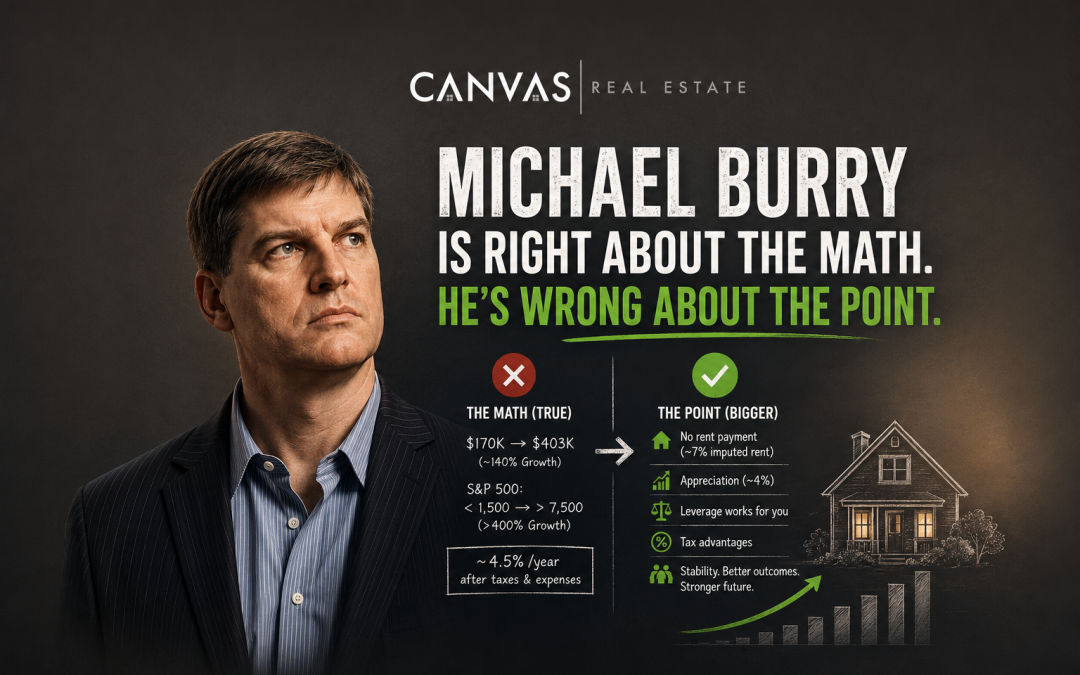
Michael Burry knows housing. He's the guy who saw the 2008 crash coming when nobody else did. So when he says buying a home is usually a mediocre investment, we should listen before we argue. In a Substack post, he wrote that he ran the numbers on owning a home over a 50-year adult life and got about 4.5% a year after taxes and maintenance. That's bond money. Not exciting. Here's the thing, though: he measured a real thing correctly, then drew the wrong conclusion from it. Your clients are going to send you this headline. Let's make sure you know how to handle it.
First, give him credit. The numbers check out. The median US home price went from about $170,000 in 2001 to about $403,000 today roughly 140% growth. The S&P 500 went from under 1,500 to over 7,500 in the same years more than 400%. Housing, in his words, "lagged the S&P 500 badly." He also makes a smart point most people miss: homes keep getting bigger, so older homes lose value over time unless the land is worth a lot. All of that is true. And none of it settles the question.
Here's the first thing to teach your agents. Comparing a home price chart to a stock chart isn't a fair fight. Your stocks don't give you a place to sleep. When you own your home, you skip a rent payment every single month. That's a real return economists call it imputed rent and it's missing from every one of those charts. Historically it's worth about 7% of the home's value each year. Add about 4% for appreciation. Take away about 1% for property taxes and 1% for upkeep. You end up around 9%. Stocks have returned about 8% to 10% long-term. The gap Burry is pointing at mostly disappears once you add back the thing he left out.
Second thing. Nobody buys stocks with 5% down. Leverage is the whole game in housing. Put $100,000 down on a $500,000 house. The home goes up just 3%. You made $15,000 on your $100,000 that's a 15% return from a 3% move. Then there's the tax code. Mortgage interest is deductible. A married couple can walk away with up to $500,000 in profit tax-free ($250,000 if you're single). Your brokerage account gets nothing like that. Now, be honest with clients here, because honesty is the job: leverage cuts both ways. A 10% drop wipes out half your equity. Ask anyone who bought in 2006. But your mortgage can't be called in the way a margin loan can. Your payment is locked. You can wait it out. That matters.
Third thing, and this one is the real killer. Burry's math assumes you rent cheap and invest the difference every month for 50 years. Almost nobody does that. The Federal Reserve found that the typical homeowner had a net worth of $396,200 in 2022. The typical renter? $10,400. That's a 40-to-1 gap. Newer numbers put it at about $430,000 versus $10,000 closer to 43-to-1. And the gap grew about 70% between 1989 and 2022. Part of the reason: only 39% of renter households take in more than they spend. Here's the stat I'd put on a slide. About 80% of homeowners own another asset that grows retirement accounts, stocks, a business. Only 48% of renters do. Owning a home doesn't stop people from investing. It goes with it. A mortgage is a savings plan you can't talk yourself out of. For most people, forced beats smart.
Now here's the part everyone skipped. Burry admitted the main reason to buy a home is what you get out of living in it the lifestyle and lifecycle benefits. He said it like it was a consolation prize. I think he just gave away the whole argument without noticing. Because that's not a soft, fuzzy feeling you can't measure. Researchers have been measuring it for decades. And the results are much bigger than 4.5%.
Start with kids. What owning really buys you isn't appreciation it's staying put. Renters move about five times as often as owners and stay about a quarter as long. That stability adds up. Habitat for Humanity found that kids of low-income homeowners are 11% more likely to finish high school and 4.5% more likely to finish college than kids of low-income renters. Research reviewed by IZA World of Labor found the same thing internationally, and found the benefits are strongest for low-income families the exact families Burry's math would talk out of buying. The reason is simple. Kids who aren't switching schools every year go to class, feel settled, and learn more. Say this to a client out loud: an 11-point jump in your kid's odds of graduating never shows up in a return calculation.
Then zoom out to the neighborhood. Homeowners are more likely to vote in local elections. They join neighborhood groups. They show up to the zoning meeting. They volunteer. Habitat found this holds true at every income level so helping lower-income families buy gives real political voice to people who usually have the least. Stability also tracks with better physical health, better mental health, and higher life satisfaction. The CDC treats housing as a key factor in health outcomes. And schools in neighborhoods where people stay have less student turnover, so teachers can actually build on last year instead of starting over. None of this shows up on Burry's ledger. All of it shows up in real life. Robert Kiyosaki calls your house a liability because it doesn't pay you. He's counting the wrong income.
So here's the whole thing in one line: Burry didn't get the math wrong. He got the scoreboard wrong. He graded a house like a stock, found out it's a bad stock, and then handed us the real answer in a throwaway sentence about lifestyle. Don't argue with his arithmetic you'll lose. Widen the frame instead. When a client waves that headline at you, don't get defensive and don't oversell. Just say: he's right, your house is a lousy stock. It was never supposed to be a stock. It's the only thing you can live in, borrow against cheaply, sell mostly tax-free, hand to your kids, and that actually makes those kids more likely to graduate. Then ask the question that ends the conversation: in 50 years, what do you want to have grown your portfolio, or your life? Good agents win that one by being the only person in the room who understood what was really being measured.