
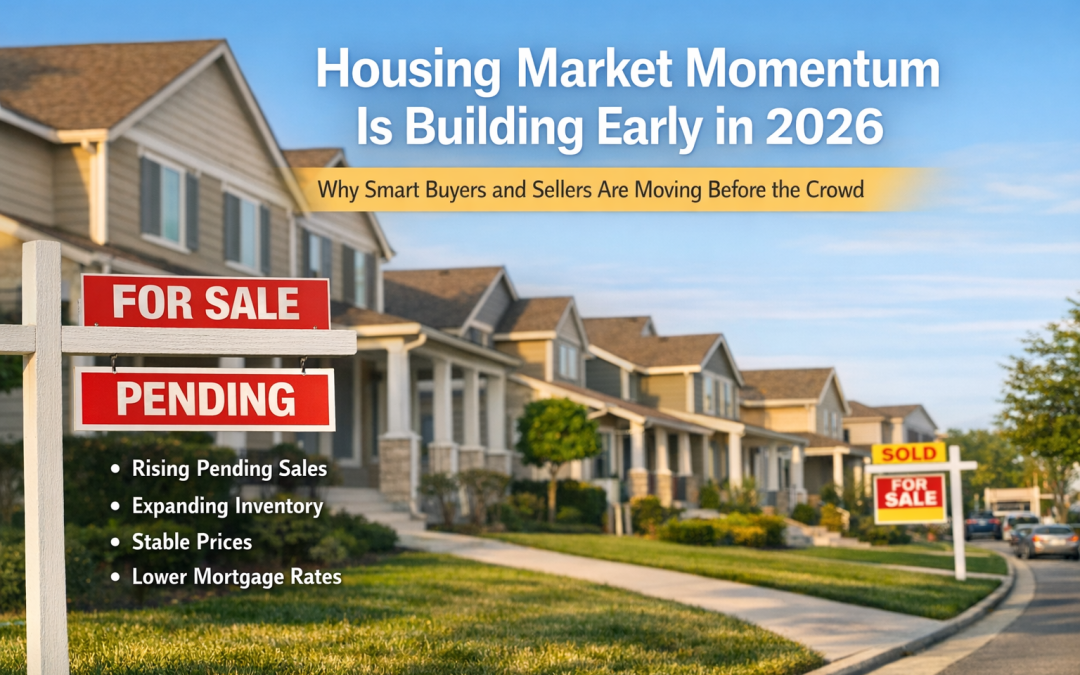
Why Smart Buyers and Sellers Are Moving Before the Crowd
As we move into 2026, the housing market is showing something we haven’t seen consistently in a while: steady, sustainable momentum.
This isn’t a frenzy.
This isn’t a crash.
It’s something healthier.
Buyer activity is improving.
Inventory is expanding.
Prices are stabilizing.
And transaction flow is beginning to normalize.
When you look closely at the data, this is exactly how durable market recoveries begin.
The Market Is Quietly Strengthening
Recent housing data shows weekly pending home sales climbing steadily through January. Mortgage purchase applications are up both week over week and year over year. That tells us buyers aren’t just browsing — they’re applying, qualifying, and preparing to transact.
Inventory has grown to roughly 2.6 months of supply. While that’s an increase, it’s still well below the 5 to 6 months typically considered a balanced market. In other words, we remain in seller-leaning territory, but with a more functional environment for buyers.
Median home prices are stabilizing around the $419,000 range. Yes, about one-third of listings are seeing price adjustments — but that reflects price discovery, not distress. Sellers who price strategically are still transacting. That’s what a healthy market looks like.
Mortgage Rates Just Crossed a Meaningful Threshold
Mortgage rates recently dipped into the 5% range for the first time in nearly three years and are now hovering in the low 6% territory.
The difference between 7% and 6% may not sound dramatic at first glance, but financially, it’s significant. On a $400,000 loan, that shift can mean more than $300 per month in savings.
That single percentage point unlocks buying power.
According to research from the National Association of Realtors, when rates sit around 6% or below:
5.5 million additional households can afford the median-priced home
Roughly 550,000 of them are likely to purchase within the next 12 to 18 months
That’s not speculation. That’s pent-up demand being activated.
And when demand activates, competition follows.
Why Buying Before the Spring Rush Could Be a Strategic Move
Every year, spring becomes the busiest season in real estate. More listings hit the market, but more buyers do too. And when demand accelerates, prices often follow.
Homes tend to sell about 20 days faster in spring than in winter. Faster markets mean:
Less negotiation time
More multiple-offer situations
Higher emotional pressure
Reduced leverage
In 2025, buyers who purchased early in the year saved approximately $30,000 to $35,000 compared to those who bought during peak spring pricing.
Waiting for more inventory or slightly lower rates may sound logical. But when hundreds of thousands of additional buyers re-enter the market, competition increases — and that can quickly offset any marginal rate improvement.
Buying before the crowd isn’t about rushing. It’s about positioning.
What This Means for Buyers
If buying didn’t work for you last year when rates were near 7%, it’s worth revisiting the numbers now.
Lower rates mean:
Lower monthly payments
Increased buying power
Stronger offers
Expanded location and property options
The difference between 6% and high 5% may be incremental. But the difference between 7% and 6% is meaningful — and that shift has already happened.
If you’ve been waiting for the right moment to reassess your budget and explore your options, this may be it.
What This Means for Sellers
We are still operating in a seller-leaning market.
Inventory remains historically tight.
Buyer confidence is improving.
Applications are rising.
Sellers who list before peak spring inventory arrives may benefit from:
Less listing competition
Motivated early-year buyers
Stronger positioning
The strongest opportunities often appear before the headlines catch up.
The Bigger Picture
The housing market has transitioned from:
Pandemic acceleration
to rate shock adjustment
to sustainable stabilization.
That combination creates durable opportunity.
Not explosive.
Not chaotic.
Strategic.
Momentum doesn’t announce itself loudly. It builds quietly — week by week.
And right now, the data suggests it’s building.
If You’re Thinking About Buying or Selling in 2026
This is not about urgency.
It’s about awareness.
If you’re a buyer, re-run your numbers. Talk to a lender. Understand what today’s rates mean for your purchasing power.
If you’re a seller, evaluate your timing. Consider whether listing before peak spring inventory could position you more effectively.
The market doesn’t reward those who follow the crowd. It rewards those who move with informed strategy.
For Real Estate Professionals Watching This Shift
Markets like this separate transactional agents from strategic advisors.
Buyers need clarity.
Sellers need positioning.
Data needs interpretation.
If you’re a driven real estate professional who wants to grow in a forward-thinking environment with leadership, strategy, and real support, let’s connect.
We are building for the next cycle not reacting to the last one.
Check out this article next