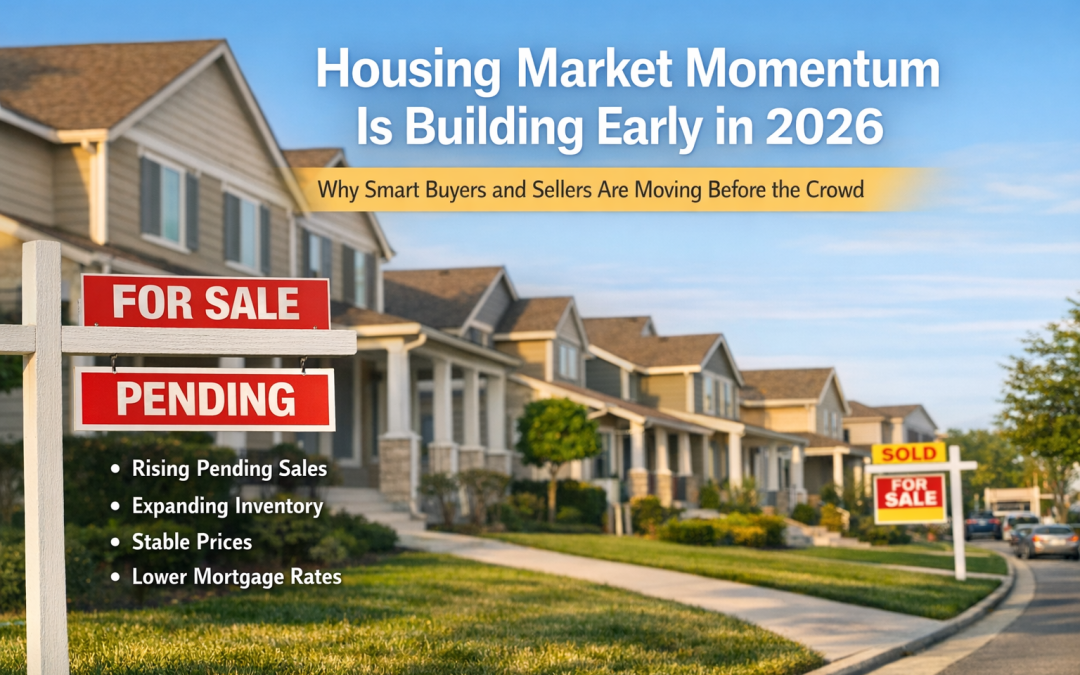
Housing Market Momentum Is Building Early in 2026

Housing Market Momentum Is Building Early in 2026

Why Smart Buyers and Sellers Are Moving Before the Crowd

As we move into 2026, the housing market is showing something we haven’t seen consistently in a while: steady, sustainable momentum.

This isn’t a frenzy.
This isn’t a crash.

It’s something healthier.

Buyer activity is improving.
Inventory is expanding.
Prices are stabilizing.
And transaction flow is beginning to normalize.

When you look closely at the data, this is exactly how durable market recoveries begin.

The Market Is Quietly Strengthening

Recent housing data shows weekly pending home sales climbing steadily through January. Mortgage purchase applications are up both week over week and year over year. That tells us buyers aren’t just browsing — they’re applying, qualifying, and preparing to transact.

Inventory has grown to roughly 2.6 months of supply. While that’s an increase, it’s still well below the 5 to 6 months typically considered a balanced market. In other words, we remain in seller-leaning territory, but with a more functional environment for buyers.

Median home prices are stabilizing around the $419,000 range. Yes, about one-third of listings are seeing price adjustments — but that reflects price discovery, not distress. Sellers who price strategically are still transacting. That’s what a healthy market looks like.

Mortgage Rates Just Crossed a Meaningful Threshold

Mortgage rates recently dipped into the 5% range for the first time in nearly three years and are now hovering in the low 6% territory.

The difference between 7% and 6% may not sound dramatic at first glance, but financially, it’s significant. On a $400,000 loan, that shift can mean more than $300 per month in savings.

That single percentage point unlocks buying power.

According to research from the National Association of Realtors, when rates sit around 6% or below:

  • 5.5 million additional households can afford the median-priced home

  • Roughly 550,000 of them are likely to purchase within the next 12 to 18 months

That’s not speculation. That’s pent-up demand being activated.

And when demand activates, competition follows.

Why Buying Before the Spring Rush Could Be a Strategic Move

Every year, spring becomes the busiest season in real estate. More listings hit the market, but more buyers do too. And when demand accelerates, prices often follow.

Homes tend to sell about 20 days faster in spring than in winter. Faster markets mean:

  • Less negotiation time

  • More multiple-offer situations

  • Higher emotional pressure

  • Reduced leverage

In 2025, buyers who purchased early in the year saved approximately $30,000 to $35,000 compared to those who bought during peak spring pricing.

Waiting for more inventory or slightly lower rates may sound logical. But when hundreds of thousands of additional buyers re-enter the market, competition increases — and that can quickly offset any marginal rate improvement.

Buying before the crowd isn’t about rushing. It’s about positioning.

What This Means for Buyers

If buying didn’t work for you last year when rates were near 7%, it’s worth revisiting the numbers now.

Lower rates mean:

  • Lower monthly payments

  • Increased buying power

  • Stronger offers

  • Expanded location and property options

The difference between 6% and high 5% may be incremental. But the difference between 7% and 6% is meaningful — and that shift has already happened.

If you’ve been waiting for the right moment to reassess your budget and explore your options, this may be it.

What This Means for Sellers

We are still operating in a seller-leaning market.

Inventory remains historically tight.
Buyer confidence is improving.
Applications are rising.

Sellers who list before peak spring inventory arrives may benefit from:

  • Less listing competition

  • Motivated early-year buyers

  • Stronger positioning

The strongest opportunities often appear before the headlines catch up.

The Bigger Picture

The housing market has transitioned from:

Pandemic acceleration
to rate shock adjustment
to sustainable stabilization.

That combination creates durable opportunity.

Not explosive.
Not chaotic.
Strategic.

Momentum doesn’t announce itself loudly. It builds quietly — week by week.

And right now, the data suggests it’s building.

If You’re Thinking About Buying or Selling in 2026

This is not about urgency.
It’s about awareness.

If you’re a buyer, re-run your numbers. Talk to a lender. Understand what today’s rates mean for your purchasing power.

If you’re a seller, evaluate your timing. Consider whether listing before peak spring inventory could position you more effectively.

The market doesn’t reward those who follow the crowd. It rewards those who move with informed strategy.

For Real Estate Professionals Watching This Shift

Markets like this separate transactional agents from strategic advisors.

Buyers need clarity.
Sellers need positioning.
Data needs interpretation.

If you’re a driven real estate professional who wants to grow in a forward-thinking environment with leadership, strategy, and real support, let’s connect.

We are building for the next cycle not reacting to the last one.

Check out this article next
Smart Money Moves First: What the Luxury Market Is Telling Us About South Florida’s Next Real Estate Wave

Smart Money Moves First: What the Luxury Market Is Telling Us About South Florida’s Next Real Estate Wave

If you want to know where the real estate market is headed, don’t watch the headlines. Watch the money.Across the country, luxury buyers are making…

Read Article
Smart Money Moves First: What the Luxury Market Is Telling Us About South Florida’s Next Real Estate Wave

Smart Money Moves First: What the Luxury Market Is Telling Us About South Florida’s Next Real Estate Wave

If you want to know where the real estate market is headed, don’t watch the headlines. Watch the money.

Across the country, luxury buyers are making decisive moves again. In markets like Manhattan, high-end real estate is rebounding toward pre-2016 levels, fueled by strong financial-sector earnings and renewed confidence. At the same time, South Florida is emerging as one of the clearest beneficiaries of this shift, particularly in ultra-luxury neighborhoods like Coconut Grove, waterfront Miami, and other legacy enclaves.

This pattern matters, because luxury real estate has always been the early signal.

Why Luxury Leads the Market

Historically, affluent buyers move first. They are less rate-sensitive, more opportunity-driven, and tend to deploy capital ahead of broader market recoveries. When they re-enter the market, it is not emotional. It is strategic.

What we are seeing right now in South Florida is a familiar setup:

  • High-net-worth individuals relocating capital to tax-friendly, lifestyle-driven markets

  • Trophy properties attracting strong interest even in a mixed-rate environment

  • Limited inventory in premium locations creating competitive pressure

In other words, smart money is positioning itself before the next broader rebound becomes obvious.

South Florida checks every box. It offers global connectivity, lifestyle appeal, favorable tax policy, and long-term demographic tailwinds. That combination continues to attract buyers who are not waiting on perfect conditions. They are buying ahead of them.

A Message for Sellers: Timing Matters

For South Florida sellers, especially those in desirable locations or well-positioned homes, this is not a moment to sit on the sidelines.

Luxury buyers are already active. They are looking for quality, value, and opportunity. Sellers who act now have the advantage of meeting demand early, before inventory expands and competition increases.

This window rewards sellers who price strategically, market professionally, and understand how to position their property to a sophisticated buyer pool. The goal is not to chase the market. It is to get in front of it.

Momentum always favors the prepared.

What This Means for Real Estate Agents

Market shifts like this also create opportunity on the professional side of the business.

Periods of transition separate transactional agents from strategic advisors. Buyers and sellers moving significant assets want expertise, data, and confidence. They want professionals who understand where the market is going, not just where it has been.

At CANVAS Real Estate, this is exactly the environment we are built for.

We attract agents who:

  • Want to work in a forward-looking, data-driven culture

  • Understand the importance of branding, positioning, and market intelligence

  • Are serious about building long-term businesses, not just chasing the next deal

As capital flows into South Florida and the luxury market leads the rebound, the opportunity for agents who align themselves with the right platform has never been stronger.

The Bottom Line

Luxury real estate is once again doing what it always does. It is moving first.

South Florida sellers have a chance to capitalize on an early wave of motivated, well-capitalized buyers. Real estate professionals have a chance to align themselves with a market and a brokerage that understands how to read these signals and act on them.

Whether you are selling, buying, or considering the next step in your real estate career, the message is the same.

Watch the smart money. Then move with it.

If you want to talk strategy, timing, or opportunities in today’s South Florida market, the conversation starts now.


Check out this article next

2026 Miami Real Estate Market: A Buyer’s Dream and a Realtor’s Opportunity.

2026 Miami Real Estate Market: A Buyer’s Dream and a Realtor’s Opportunity.

Welcome to 2026! Miami isn’t just warm and sunny – it’s one of the most buyer-friendly markets in the country, and that has big implications for…

Read Article
2026 Miami Real Estate Market: A Buyer’s Dream and a Realtor’s Opportunity.

2026 Miami Real Estate Market: A Buyer’s Dream and a Realtor’s Opportunity.

Welcome to 2026! Miami isn’t just warm and sunny – it’s one of the most buyer-friendly markets in the country, and that has big implications for professionals who want to thrive in real estate. Pending home sales in our metro rose 6.3% year-over-year in December even as national pending sales dropped around 9%. Miami ranked 8th among major metros for pending-sale growth, putting us in the same conversation as Louisville, San Antonio and Charlotte. Buyers are writing offers and contracts are being signed – and savvy agents can ride this momentum to build bigger businesses and attract more clients.

Why Miami Is Bucking the National Slowdown

  • Momentum matters: Pending sales – homes under contract but not yet closed – are the best forward indicator of closings in the next 30–60 days. A 6.3% increase means fuller pipelines, more inspections, and more deals moving toward the finish line.

  • Structural demand: Population growth, tax advantages, international investment and the influx of finance, tech and remote workers all feed long‑term housing demand. Miami’s boom isn’t a pandemic blip; it’s a sustained trend.

  • Tight but advantageous inventory: Inventory is still limited in our most desirable neighborhoods (waterfront, top school zones, walkable districts), yet rising pending sales show that competitively priced homes still attract motivated buyers. Listing agents have leverage when they price and present well.

  • Balanced market dynamics: Miami home values (about $466,000) are expected to rise at a modest 2.5% annually. Buyers enjoy more listings, more days on market and fewer bidding wars – which means more negotiating power and less stress – while sellers are still closing at healthy prices.

What Buyers and Sellers Need to Know

For sellers: This isn’t 2021’s frenzy, but it isn’t a crash either. Contracts are being written, yet today’s buyers are discerning. Condition, pricing and presentation matter. Sellers who come to market at or near realistic value, with strong curb appeal and flexibility, will move quickly and cleanly.

For buyers: You finally have breathing room. There are more options, more negotiating leverage and time for due diligence. Waiting for a mythical “perfect crash” means missing opportunities. Get pre‑approved, know your budget and be ready to act when the right home appears. Today’s market rewards preparation and realistic expectations – not hesitancy.

9 Actions for Real Estate Professionals in February 2026

To dominate this buyer‑friendly market and grow your business, follow this daily action plan throughout February:

  1. Connect With Your Sphere (30–60 minutes daily). Call or text 5–10 past clients, friends or farm contacts with a simple script: “Miami pending sales are up 6.3% while the rest of the country is down about 9%. Our market is moving—do you know anyone thinking of making a move in 2026?” Share one market stat daily via short video or story, always tied to a neighborhood or price point.

  2. Target Listings in Tight Pockets (30 minutes daily). Each morning, pull data on neighborhoods with low inventory but strong buyer activity. Send 5–10 targeted letters or messages to homeowners: “Homes like yours are still going under contract quickly when priced right – buyers are still competing for your area.”

  3. Move One Buyer & One Seller Forward (30–60 minutes daily). For buyers: get someone pre‑approved, refine a budget, show a home, or negotiate an offer. Use the story that more inventory and negotiation power make this a smart time to buy. For sellers: update a net sheet, refine a pricing strategy, schedule photos or staging. Emphasize that the market is healthy, but preparation is key.

  4. Improve Your Skills (20–30 minutes daily). Practice price‑conversation scripts, buyer pre‑approval scripts and negotiation scenarios. Update your CRM follow‑up plan or listing checklist. In 2026, the agents who operate like pros – with better conversations and tighter systems – will stand out.

  5. Educate Your Audience. Host a “Buyer Strategies 2026” webinar or social‑media live session covering Miami’s buyer‑friendly ranking, negotiation tips and mortgage options. Use data to reinforce your expertise and invite potential recruits to learn how your brokerage supports agents.

  6. Market to Empty‑Nest and Early‑Retiree Sellers. Nearly 12,000 Americans turn 65 every day. Many want simpler, smaller homes near family and amenities. Craft marketing campaigns that highlight the benefits of downsizing: less maintenance, more freedom and the ability to tap into record home equity.

  7. Leverage Equity for Move‑Up or Downsize Purchases. Seniors hold over $14 trillion in housing wealth. Show owners how selling a big family home can fund a new condo, villa or one‑story home – sometimes with little or no mortgage. Partner with lenders on creative financing and bridge solutions.

  8. Highlight Miami’s Lifestyle & Tax Advantages. Share content about our year‑round warm weather, beach proximity, cultural scene and tax benefits. Many buyers in finance, tech and Latin American industries are relocating from high‑tax states. Position yourself as the resource for their transition.

  9. Recruit Through Success. As you implement these strategies, share your wins publicly. Blog posts, market updates, client testimonials and behind‑the‑scenes content showcase your professionalism and results. Invite fellow agents who feel stuck in slow markets to join a brokerage that’s thriving despite national headwinds. At Canvas Real Estate, we provide the training, technology and supportive culture that empower agents to crush it in a balanced market like Miami.

Final Thoughts

National headlines may talk about housing declines, but Miami is writing more contracts than ever. With pending sales rising and buyer friendliness ranking near the top nationally, South Florida is a rare mix of opportunity and stability. As a realtor or mortgage professional, 2026 isn’t the year to sit on the sidelines. It’s the year to double down on data, sharpen your skills, and serve clients who are ready to move. In doing so, you’ll not only grow your own business but also attract like‑minded professionals who want to be part of a winning team.

Ready to crush it this February? Let’s leverage this buyer’s dream market – and build the strongest real estate community Miami has ever seen.

Check out this article next

South Florida Real Estate: 2026 Growth & Opportunities for Buyers, Sellers & Realtors

South Florida Real Estate: 2026 Growth & Opportunities for Buyers, Sellers & Realtors

As someone immersed in real estate every day, I see the trends and feel the market’s pulse. Today, I’m more confident than ever that home…

Read Article
South Florida Real Estate: 2026 Growth & Opportunities for Buyers, Sellers & Realtors

South Florida Real Estate: 2026 Growth & Opportunities for Buyers, Sellers & Realtors

As someone immersed in real estate every day, I see the trends and feel the market’s pulse. Today, I’m more confident than ever that home prices in South Florida will continue to rise — thanks to powerful economic tailwinds and demographic shifts that make our region a magnet for talent and investment.

South Florida’s Economy: A Global Powerhouse

Florida is now a nearly $1.7 trillion economy, the fourth-largest in the United States and bigger than the GDP of many countries, including Spain. Over the past five years, our state’s gross domestic product has consistently ranked among the fastest-growing in the nation.

Zoom in on the Miami-Fort Lauderdale-West Palm Beach region and the story gets even more compelling: the tri-county area generates $400 billion in annual economic activity and supports over 2.5 million jobs. From finance and technology to tourism and logistics, our local job market is diversified and robust. Unemployment hovered around 3.7% in mid-2025, while job growth continued to outpace the national average.

A Hub for Business & Entrepreneurship

Florida ranked #1 in the nation for new business formations in 2025, with nearly 700,000 new companies created statewide. More businesses mean more executives, entrepreneurs and employees relocating here creating a steady influx of buyers and renters looking for homes.

As billionaire investor Ken Griffin put it, South Florida offers “deep talent, regulatory clarity, and quality of life.” Developer Steve Ross echoes that sentiment, calling it “the place where the next generation of companies belongs.” Capital follows fundamentals, and the fundamentals in South Florida are powerful.

What This Means for Buyers

For homebuyers, this growth creates both urgency and opportunity. With a strong local economy, increasing population, and rising wages, demand for housing is set to remain high. Buying in 2026 could allow you to lock in today’s prices and start building equity before values climb further.

Many think they should “wait for the crash,” but those who have followed our market know that South Florida tends to outperform national trends. If you’re ready to invest in a home, our market offers stability, long-term appreciation potential and a vibrant lifestyle.

What This Means for Sellers

If you’re considering selling, now might be an ideal time. Tight inventory and rising demand mean well-priced homes continue to attract serious buyers. With interest rates relatively stable and the economy expanding, you can capitalize on strong buying power to achieve top dollar.

Even if you need to downsize or relocate, the equity you’ve built could provide the financial flexibility to make your next move more comfortably.

A Special Invitation to Real Estate Professionals

With over 1000 agents, I’ve seen how the right brokerage support can magnify individual success. At CANVAS Real Estate, we’re uniquely positioned to capture this next wave of growth. Our training programs, technology tools and collaborative culture help agents thrive in a competitive market. If you’re looking for a brokerage that invests in its people and shares your ambition, consider joining our team.

Final Thoughts & Call to Action

The question isn’t whether the South Florida market will grow — it’s who will capture that growth. If you’re a buyer or seller ready to take advantage of this extraordinary environment, reach out today. We’re here to guide you through every step of the process, armed with data, experience, and a deep commitment to your success.

And if you’re a real estate professional seeking a supportive, growth-oriented environment, we’d love to talk about how CANVAS Real Estate can help you reach new heights. Together, we can make the most of South Florida’s booming real estate landscape and build lasting success. 

Check out this article next
Tourism, Credit Myths, and Timing: Three Hidden Advantages for South Florida Homebuyers (and Smart Agents)

Tourism, Credit Myths, and Timing: Three Hidden Advantages for South Florida Homebuyers (and Smart Agents)

Tourism: The Front Door to South Florida Real EstateTourism isn’t just about vacations in Miami and Fort Lauderdale it’s the front door to our entire real estate…

Read Article
Tourism, Credit Myths, and Timing: Three Hidden Advantages for South Florida Homebuyers (and Smart Agents)

Tourism, Credit Myths, and Timing: Three Hidden Advantages for South Florida Homebuyers (and Smart Agents)

Tourism: The Front Door to South Florida Real Estate

Tourism isn’t just about vacations in Miami and Fort Lauderdale it’s the front door to our entire real estate economy. Visitors come for the beaches, weather, restaurants, and nightlife, and they leave with something much bigger: the idea of owning a piece of South Florida.

That first visit plants a seed:

Over time, that seed grows into real demand for:

Every plane that lands and every cruise ship that docks brings future renters, future second‑home buyers, and future full‑time residents. Tourism keeps outside money flowing into our market and helps support values across Miami‑Dade, Broward, and Palm Beach.

For consumers, that means you’re buying into a market with deep, diversified demand. For real estate agents, it means every tourist is a future lead—if you know how to stay in touch after the vacation ends.

Visitors Become Renters, Owners, and Investors

Most people don’t wake up and randomly choose a city to buy a home in. They visit first. They fall in love with the lifestyle, then they start running the numbers.

The typical journey looks like this:

Investors follow the same path. Strong tourism means high occupancy, strong nightly and seasonal rates, and attractive returns. That drives demand for:

At the same time, tourism supports local jobs in hospitality, restaurants, retail, transportation, and construction. Those workers need rentals and starter homes, which keeps demand strong from the bottom of the market all the way up.

If you live here, this is why your property has staying power. If you’re an agent, this is why your pipeline should always include visitors, hospitality workers, and investors—not just traditional local move‑up buyers.

The Credit Score Myth Keeping Renters on the Sidelines

While tourism is constantly creating new demand, a huge number of would‑be buyers are quietly sitting on the sidelines because of one thing: fear about their credit score. Many renters assume that unless their credit is “perfect,” there’s no point in even talking to a lender.

Here’s what most people don’t realize:

The result is a dangerous pattern: renters who could qualify never apply. They “self‑reject” before the process even starts. That delay can cost them years of missed equity, higher future prices, and rising rents.

If you’re a consumer reading this, the takeaway is simple: don’t guess. Have a conversation with a trusted lender and get real numbers. If you’re an agent, your job is to replace credit myths with facts and make that introduction early.

Why Timing Still Matters: The Hidden Advantage of the Calendar

On top of tourism‑driven demand and credit myths, there’s a third factor many buyers overlook: timing. Home prices and competition follow a seasonal rhythm.

For South Florida, where weather is less of an obstacle, January and February can be an especially smart time to shop. You’re not just fighting locals—you’re also ahead of many out‑of‑state buyers who plan trips and home searches closer to spring and summer.

Buyers who understand this can save meaningful money on purchase price and terms. Agents who understand this can position their clients to win quietly while everyone else is waiting for “the busy season.”

Why CANVAS Real Estate Is Leaning Into This Shift

At CANVAS Real Estate, we see these three trends tourism, credit myths, and timing as massive opportunities for both consumers and agents:

For buyers and sellers, we focus on:

For agents who are serious about their careers, we offer:

If you’re a consumer, your next step is simple: start a low‑pressure conversation about your options whether that’s owning here for the first time, turning a vacation dream into a second home, or using your good payment history as a renter to finally become an owner.

If you’re an agent who wants to build a real, sustainable business in a tourism‑fueled, year‑round market like South Florida, your next step might be a conversation with us at CANVAS Real Estate. The opportunities are here. The visitors are here. The only question is whether you have the right platform and support to capture them.

Check out this article next

What Today’s Housing Headlines Really Mean for Your Clients and Your Career

What Today’s Housing Headlines Really Mean for Your Clients and Your Career

Read Article
What Today’s Housing Headlines Really Mean for Your Clients and Your Career

What Today’s Housing Headlines Really Mean for Your Clients and Your Career

Real estate is entering one of those moments where headlines are louder than reality.

Between talk of banning institutional investors and a $200 billion mortgage bond program, many buyers, sellers, and even agents are unsure what to believe.

So let’s simplify what actually matters.

The Investor Ban: More Headline Than Market Shift


The proposal targets future purchases by very large institutional investors.

  • It does not force sales.
  • It does not flood inventory.
  • It does not affect small investors.

Institutional ownership nationally is about 3% of single-family homes. In South Florida, it is even lower.

The real affordability issue has never been investors.

It is supply.

We are not building enough homes. Until that changes, affordability will remain pressured regardless of who buys.

The $200B Mortgage Bond Plan: A Short Window


The government has directed Fannie Mae and Freddie Mac to purchase $200 billion in mortgage-backed securities. This can temporarily stabilize rates.

  • Not dramatically.
  • Not permanently.
  • But meaningfully for buyers who act early.

This is a short opportunity window, not a long-term solution.

What This Means for Buyers


Buyers who win in this market:

  • Move before competition returns
  • Negotiate intelligently
  • Focus on payments, not headlines

This is a strategy market, not a speculation market.

What This Means for Sellers


Most sellers are also buyers. That means pricing, positioning, and timing matter more than ever.

Homes that sit longer create leverage. Homes priced correctly create momentum.

What This Means for Realtors


This market is not about motivation. It is about interpretation.

Agents who can clearly explain what is short-term, what is structural, and what is local will earn trust and transactions.

Why CANVAS Real Estate Exists


At CANVAS, we are not building a brokerage around hype.

We are building a brokerage around:

  • Education
  • Market clarity
  • Systems
  • Culture
  • Long-term growth

Our agents are trained to lead conversations, not chase them.

For Buyers and Sellers


You do not need predictions.

You need a plan.

And you need professionals who understand how to build it.

For Realtors


This market is filtering professionalism.

The agents who grow in 2026 will not be the loudest. They will be the clearest.

If you are a real estate professional looking for a smarter platform, stronger leadership, and a long-term vision, CANVAS Real Estate was built for you.

Final Thought


This market is not broken.

It is simply asking for better professionals.

At CANVAS, we are building them.