Miami-Dade just did something no American housing market has done before, and it happened almost quietly. Twenty-nine single-family homes sold for $30 million or more in 2025 shattering the previous record of 15 set in 2024 and before 2020, the county never saw more than three such sales in an entire year. This year the pace has doubled again: 21 single-family homes have already closed above $30 million, and counting condos, Analytics Miami counted 24 trophy sales in the first half of 2026 alone. The market is on track to blow past 2025's record of 33. It's tempting to read that as a story about billionaires and gated islands, disconnected from the family shopping for a three-bedroom in Kendall. It isn't. The top of this market is the engine, and the drive shaft runs straight through the rest of the county.
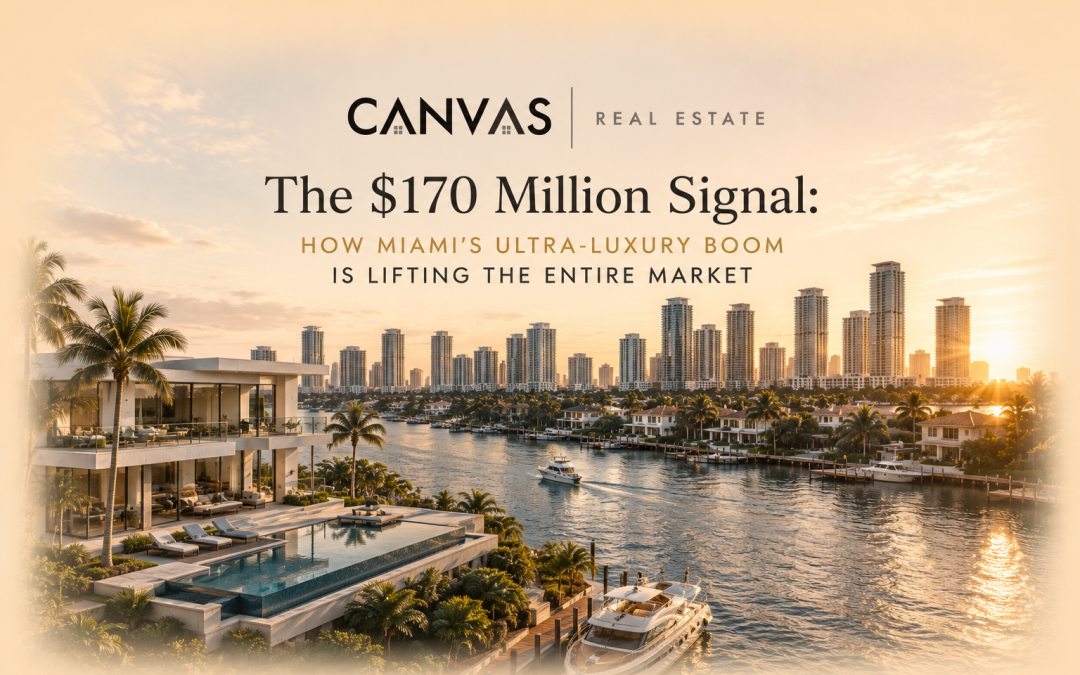
The headline number is the one everybody knows. In March, Meta CEO Mark Zuckerberg and Priscilla Chan closed on a 30,000-square-foot estate at 7 Indian Creek Island Road for $170 million the most expensive residential transaction in Miami-Dade history, blowing past the $120 million Star Island record set just a year earlier. It was listed at $200 million in November; the sellers had bought the two-acre site for roughly $30 million in 2020 and built the house in the years since. Zuckerberg joins Jeff Bezos, Carl Icahn, Tom Brady, and a roster of others on the island locals call the Billionaire Bunker. As Douglas Elliman's Devin Kay put it, $30 million sales used to be rare in South Florida and now happen monthly, with the ceiling pushing north of $100 million territory Florida simply never occupied before.
Zoom out and the aggregate is more impressive than any single trophy. Buyers spent $13.7 billion on Miami-Dade residential real estate in the first half of 2026 up 19% year over year and up 101% from pre-pandemic levels. That is a doubling of an entire county's residential transaction economy in roughly six years. Miami has now logged more $30 million-plus deals than New York City, which recorded 17 in the same stretch. South Florida transactions above $10 million doubled year over year in the first quarter, setting a record, according to ISG World. And the buyer base keeps deepening: the millionaire population of Miami grew 94% between 2014 and 2024, per Henley & Partners, with Bezos, Ken Griffin, and Howard Schultz among those who made Miami-Dade their primary residence.
Here's where the trickle-down stops being a slogan and starts being arithmetic. MIAMI Realtors and RWorld estimate that every $1 of direct spending on real estate structures generates $1.90 in direct and indirect spending across the regional economy. The sale and use of a single existing home at the median price produces roughly $100,100 in economic impact across South Florida and $117,800 in Miami-Dade, where prices run higher. Real estate and rental and leasing is the single largest contributor to GDP in Miami-Dade, Broward, and Palm Beach counties, which together produce more than $400 billion in combined real GDP. Money that enters this market does not sit in a vault on a private island. It circulates.
Follow one deal and you can see the circulation. The Zuckerberg estate was still under construction when it traded nine bedrooms, 11 baths, a dock, a 1,500-gallon aquarium, custom millwork, imported limestone. That's years of paid work for framers, marine contractors, electricians, landscape crews, glaziers, cabinet shops, pool builders, and the architects and project managers who ran it. Multiply that across a county that added more than $8 billion in new construction value to the tax roll in a single year, and you're describing a payroll, not a purchase. Every trophy transaction also pays inspectors, title companies, insurers, appraisers, movers, stagers, and photographers the working middle of an industry that most people never think about when they read a nine-figure headline.
Then there's the public balance sheet, which is where the benefit becomes least glamorous and most universal. Miami-Dade's countywide preliminary taxable value for 2026 came in at $540.1 billion, a 5.4% increase over 2025. That's the pool that funds public schools, police and fire, parks, libraries, and drainage. The structural detail matters here: Florida's Save Our Homes cap limits annual assessment increases on homesteaded properties to 3% or the change in CPI, whichever is lower, while a trophy property reassesses at full market value the moment it changes hands. A $170 million sale resets that parcel's contribution permanently, while the assessment on the homesteaded bungalow down the road stays capped. New arrivals at the top of the market are, quite literally, buying into the tax base at full price while long-time residents are shielded from the reassessment.
Capital also brings employers, and employers bring payrolls that reach far past the waterfront. Family offices, funds, and financial firms have followed their principals south the "Wall Street South" build-out that FAU economists have tracked through consistent employment and salary growth in finance and professional services. Miami-Dade now counts over 126,000 businesses. Those firms hire analysts, compliance staff, IT teams, paralegals, and office managers, and those employees rent apartments, buy starter homes in Cutler Bay and Miami Gardens, eat in neighborhood restaurants, and put children in local schools. The billionaire buys the island; the sixty people he employs buy into the mid-market. That second wave is where most of the volume and most of the jobs actually live.
And that mid-market is where the most underappreciated good news sits. The same divergence that produced record trophy sales has produced real leverage for ordinary buyers. Analytics Miami's early-2026 data showed a Miami-Dade median single-family price of $685,000, up 5% year over year, while the median condo price sat at $415,000, down 8% even as post-2010 condos hit an all-time-high median of $715,000, up 15%. Older condo inventory has swelled to roughly 14 months of supply in Miami-Dade, well past the six-to-nine months that defines a balanced market. Translation: while the top end sets records, a buyer shopping under $500,000 has more inventory, more negotiating room, and more time to think than at any point since 2019. Two markets, moving in two directions, and only one of them gets headlines.
So what does a $170 million trade on a private island have to do with a family closing on a townhouse in Cutler Bay? Considerably more than the headline suggests. It means a deeper tax roll funding their kids' schools, a longer construction pipeline employing their neighbors, wider payrolls at the firms setting up in Brickell, and a global capital base that no longer treats Miami as a seasonal stop but as a permanent address. Waterfront will keep getting more expensive single-family inventory is down 30% from pre-pandemic levels and nobody is manufacturing more coastline but scarcity at the very top is precisely what pushes capital, development, and jobs outward into the neighborhoods where most of this county actually buys. Miami spent forty years being described as an emerging market. That description is finished. The world's wealth has stopped visiting and started settling, and settled wealth builds: it funds the public balance sheet, fills job sites, finances new inventory, and underwrites the long-term value of every parcel from Indian Creek to Hialeah. The record price isn't the story. The floor it just raised is.