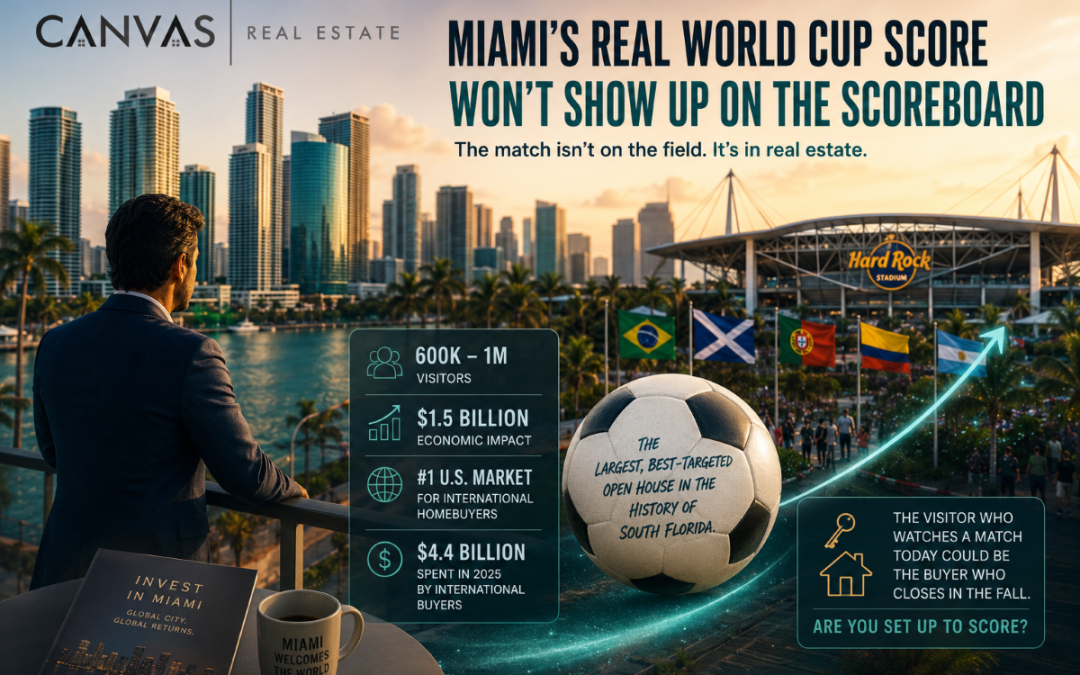
For six weeks this summer, Miami isn't just hosting seven World Cup matches at Hard Rock Stadium it's auditioning for the world. And here's the part most people watching the games will completely miss: the most important play of this tournament has nothing to do with soccer. While fans argue over Brazil vs. Scotland, brokers and developers across South Florida are running a far quieter, far more lucrative game. The Miami Host Committee's chief marketing officer put it bluntly this is "seven Super Bowls back-to-back." But the real question isn't how many visitors show up. It's how many of them never fully leave.
The numbers are eye-watering. Miami-Dade projects 600,000 to 1 million visitors and a $1.5 billion economic impact nearly triple the boost from Super Bowl LIV, because a single Super Bowl is roughly ten days of activation versus more than a month of World Cup. But here's what should actually grab every real estate professional's attention: Miami is already the No. 1 U.S. market for international homebuyers, where foreign buyers account for roughly 15% of total residential dollar volume. In 2025, international buyers spent $4.4 billion on South Florida residential real estate a 42% jump year over year — and they now make up over half of new-construction and pre-construction condo sales. The World Cup isn't creating this demand. It's pouring jet fuel on a fire that was already burning.
Now watch how the pros are actually playing it, because this is the masterclass. Developers aren't waiting for buyers to wander in — they're hosting watch parties, dangling incentives, and using the tournament to walk international prospects straight into pre-construction projects. The logic is surgical: buyers from Brazil, Colombia, Argentina, and Mexico are already Miami's most active foreign purchasers, and the city's deep ties to Latin America mean these visitors already half-belong here. As one top broker described a recent deal: "Did he buy because of the World Cup? No. Did it accelerate his decision? Yes." That's the whole strategy in one sentence the tournament isn't manufacturing buyers, it's compressing months of hesitation into a single electric weekend with a skyline view from the balcony.
And the matchups themselves are a targeting map. Hard Rock is hosting some of the most globally watched games on the schedule Brazil vs. Scotland, Portugal vs. Colombia which have already generated the highest short-term-rental booking numbers of the entire tournament. Saudi Arabia plays Uruguay in Miami on opening weekend, a detail that won't be lost on Gulf sovereign wealth and private investors already circling South Florida's luxury condo market. There's even a precedent worth studying: Paris saw foreign real estate interest surge more than 70% heading into the 2024 Olympics. The visitor-to-buyer pipeline is a proven pattern, and Miami is about to run the most powerful version of it ever attempted on U.S. soil with no state income tax and foreign-friendly investment laws sweetening every pitch.
But let me put on my honest-broker hat, because the smartest professionals price in the skeptics too. Not everyone's buying the billion-dollar fairy tale. Sports economists have called these FIFA-commissioned projections "wildly exaggerated," noting that local fans' ticket money flows to FIFA, not the neighborhood, and that hotel and travel spending often "leaks out" of the local economy. Miami-Dade is spending around $46–53 million in public funds cash, police, and services to host, and the county quietly reallocated a $3 million "legacy project" fund to anti-violence and small-business grants instead. The lesson? The windfall isn't automatic, and it doesn't rain down evenly. It accrues to the players positioned to capture it the developer with the right pre-construction inventory, the agent with the Brazilian client list, the operator who built the relationship before kickoff.
So here's the real takeaway for anyone in South Florida real estate: the World Cup's lasting value won't be measured in July it'll show up in the years after the crowds go home. Miami already had the trajectory of a world-class global city; this tournament just hands it six weeks of undivided global attention, and a G20 summit is reportedly next on the calendar. The infrastructure stays. The media exposure compounds. The visitor who watched a match from a Brickell balcony becomes the buyer who closes in the fall. The agents and developers who win this summer won't be the ones who got lucky with foot traffic they'll be the ones who treated a soccer tournament as what it actually is: the largest, best-targeted open house in the history of South Florida. The whistle's about to blow. The question is whether you're set up to score. ⚽🔑 South Florida pros is the World Cup a genuine market accelerant or an overhyped month? I want your honest read below.