
Every time the word “foreclosure” starts appearing in headlines, something predictable happens.
People immediately think back to 2008.
For many Americans, the housing crash left a permanent impression. Entire neighborhoods were filled with distressed sales, home values collapsed, and foreclosures became a defining feature of the market.
So when new reports show foreclosure activity ticking up slightly, it’s natural for people to wonder:
Is the housing market heading back in that direction?
The short answer is no. Not even close.
But understanding why is important for buyers, sellers, investors, and real estate professionals across South Florida, where housing demand remains one of the strongest in the country.
Yes, Foreclosure Filings Are Rising Slightly
Let’s start with the reality.
Foreclosure filings have increased modestly in recent months. That’s true.
But the scale of the increase matters.
According to housing data provider ATTOM, only 0.3% of all homes in the United States are currently in some stage of foreclosure.
That means 3 out of every 1,000 homes.
That’s not a wave.
That’s barely a ripple.
Serious Mortgage Delinquencies Are Still Extremely Low
To understand foreclosure risk, economists typically look at serious delinquencies, which means mortgages where homeowners are more than 90 days behind on payments.
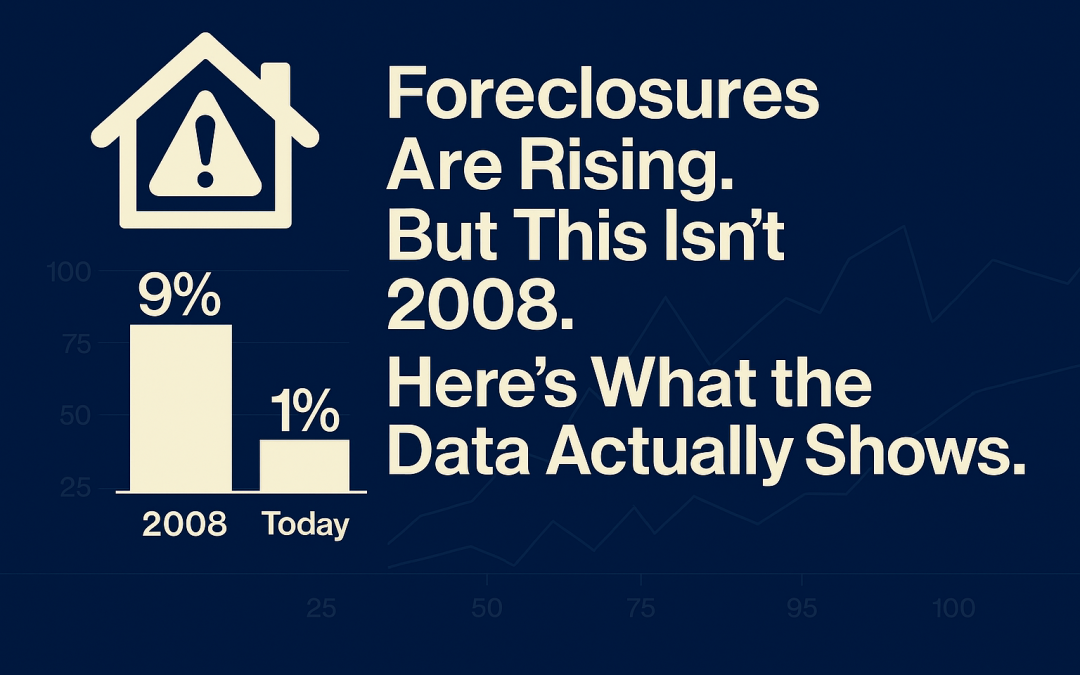
According to data from the New York Federal Reserve, serious mortgage delinquencies currently sit at around 1% of all loans.
That’s 1 out of every 100 mortgages.
Now compare that to what happened during the housing crash.
In the years around 2008, serious delinquencies climbed to nearly 9% of all mortgages.
That’s 1 out of every 11 homeowners falling significantly behind on their payments.
The difference between 1% and 9% is massive.
And it highlights something important: today’s housing market looks fundamentally different from the one that collapsed nearly two decades ago.
Homeowners Today Are in a Much Stronger Position
One of the biggest differences between today’s market and the pre-crash era is home equity.
Over the past several years, rising home prices have created significant wealth for homeowners.
Millions of households now have substantial equity in their homes.
And that equity creates options.
If a homeowner starts experiencing financial pressure, they can often sell the property, pay off the mortgage, and walk away with cash, rather than losing the home to foreclosure.
As Daren Blomquist, VP of Market Economics at Auction.com, explains:
“Distressed homeowners… many times they still have equity in their homes. There’s an opportunity for them to sell that home, avoid foreclosure, and walk away with equity.”
That dynamic simply didn’t exist during the housing crash.
Back then, millions of homeowners owed more on their mortgage than their homes were worth. Selling wasn’t an escape.
Today, it often is.
Americans Protect Their Homes First
Another interesting trend economists are watching right now involves how households prioritize debt.
Data from the New York Fed shows that delinquencies are rising more quickly in credit cards and auto loans than in mortgages.
In other words, when financial pressure hits, people may fall behind on other obligations.
But they fight hard to protect their home.
That’s one of the reasons mortgage delinquency levels remain relatively stable even during periods of economic uncertainty.
For most households, the mortgage payment remains the highest financial priority.
What This Means for South Florida
In Miami-Dade, Broward, and Palm Beach counties, the housing market continues to be supported by several strong fundamentals:
ongoing migration into Florida
limited housing supply
international buyer demand
strong equity positions among homeowners
Even in markets where prices have cooled slightly from their pandemic peaks, the structural demand for housing in South Florida remains strong.
That’s why foreclosure activity here, much like the rest of the country, remains extremely low by historical standards.
For buyers, this means the market is adjusting, not collapsing.
For sellers, it reinforces the fact that most homeowners still hold meaningful equity in their properties.
The Opportunity for Real Estate Professionals
Moments like this create an interesting dynamic in the industry.
When headlines create uncertainty, consumers start asking more questions.
And that’s where great agents step in.
The agents who understand market data, who can explain the difference between normal market adjustments and true market distress, are the ones who earn trust and build long-term relationships with clients.
At CANVAS Real Estate, we’ve built our reputation across South Florida by focusing on exactly that.
Education.
Market insight.
And helping both buyers and sellers navigate the market with clarity instead of fear.
It’s one of the reasons CANVAS has grown into one of the most recognized and fastest-growing real estate firms in South Florida.
The Bottom Line
Yes, foreclosure filings are rising slightly.
But they remain far below anything resembling crisis levels.
Serious mortgage delinquencies are still historically low.
Homeowners today have record levels of equity.
And most households continue to prioritize their mortgage payments above other debts.
So while headlines may grab attention, the data tells a much calmer story.
This isn’t 2008 all over again.
It’s simply a housing market finding its balance.
And for buyers, sellers, and the agents guiding them, that balance often creates opportunity.
Check out this article next